Trade corridors · World
Border reform moves from tariff schedules to the loading bay
Demo journalism: An invented regional customs pact tests whether shared paperwork can matter more than another tariff concession.
By Ilan Corven · 4 min read
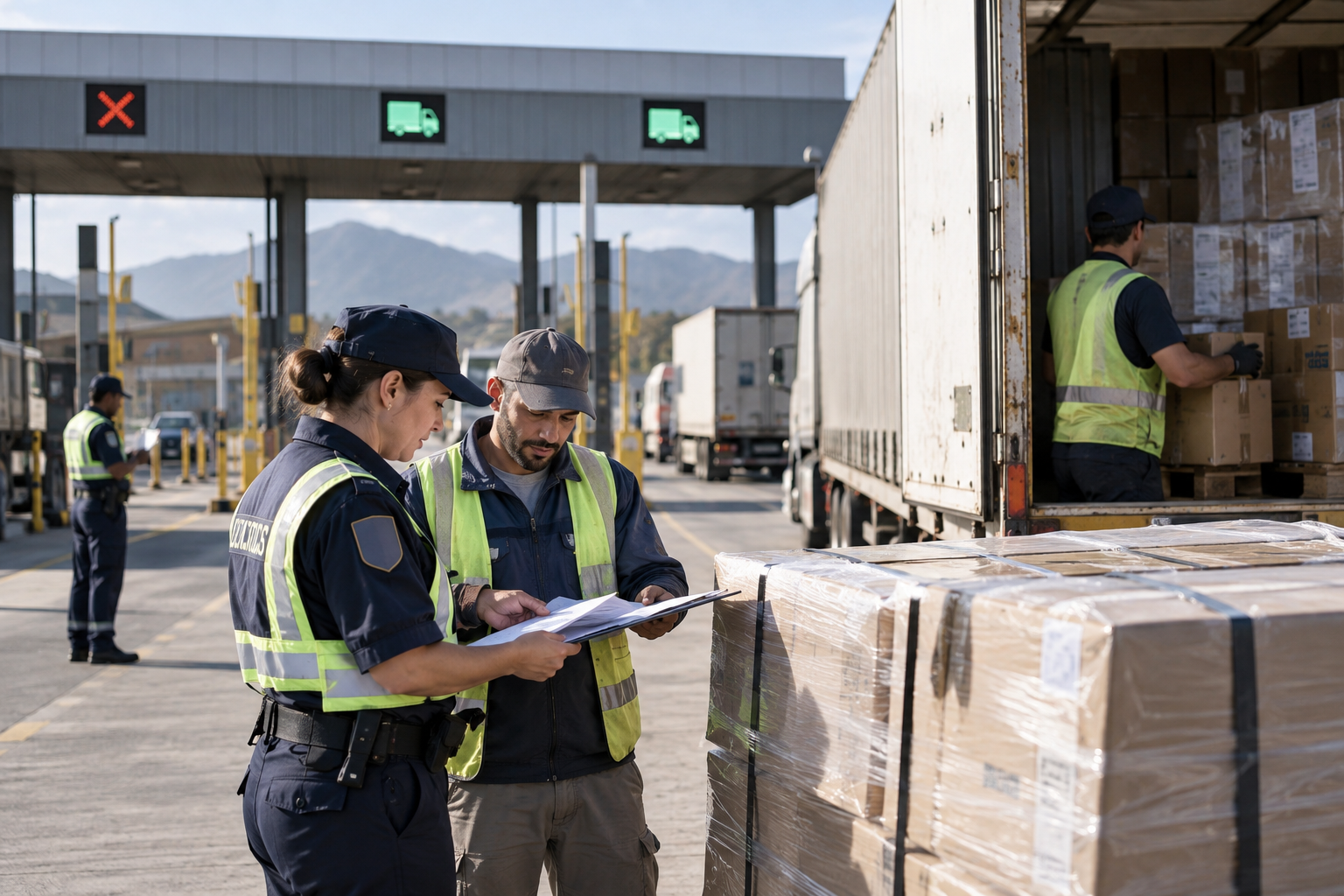
In the fictional Selwick Corridor, the next trade concession is being negotiated not in a tariff schedule but at the loading bay. Officials designing a regional customs pact are testing whether accepting the same digital paperwork before a truck arrives can do more for commerce than another reduction in import duties. A demonstration involving six border posts has reduced the median administrative wait from 19 hours to 11 hours, shifting the debate from what traders pay at the frontier to how long their goods remain there.
The eight-hour reduction amounts to a 42.1% improvement, achieved in the exercise without changing safety standards or staffing. The proposed agreement also reserves $18 million for shared filing centres and requires a paper fallback, provisions intended to keep smaller operators from being excluded. All figures belong to the fictional demonstration rather than an observed regional economy. Its central proposition is nevertheless familiar to trade negotiators: when tariffs are already modest, predictable clearance can become a more valuable commercial asset than a further cut in border taxes.
The pact’s diplomatic bargain is mutual recognition of routine checks, not the removal of inspection powers. Participating authorities would accept a common digital manifest submitted before arrival, avoiding repeated transcription and allowing preliminary reviews to begin while freight is still moving. Customs officers would retain their ability to inspect cargo and challenge declarations. That distinction matters politically. Governments would be sharing confidence in administrative processes rather than surrendering control over their borders, a narrower commitment that could prove easier to sustain when relations become strained.
Read more: A model compact puts public contracts at the centre of democratic renewal
The demonstration’s planning baseline assumes 240,000 truck crossings annually across the six posts, up 4% from the previous simulated year, with declared goods worth $9.6 billion. That implies an average cargo value of $40,000 per crossing. At an assumed average tariff of 2.5%, the baseline produces $240 million in annual duties before exemptions. A further tariff concession of 25 basis points would save traders $24 million on the same goods base. Those assumptions help explain why negotiators have turned towards paperwork: even relatively small operational improvements could rival the value of conventional tariff bargaining.
The financial comparison is suggestive rather than conclusive. At an assumed standing cost of $45 per truck-hour, an eight-hour saving would be worth $360 per crossing. If the reduction applied to every crossing, annual savings would reach $86.4 million, or 0.9% of the declared value of goods. But the demonstration reports a median, not a mean, and cannot establish that every truck would save eight hours. Nor does the administrative measure capture every source of delay, including road congestion, warehouse queues and time spent awaiting commercial instructions. The headline improvement should not be mistaken for a guaranteed reduction in door-to-door delivery times.
Distribution is the more immediate source of contention. In the exercise’s assumed traffic mix, large carriers account for 65% of crossings, while smaller operators handle the remaining 35%, equivalent to 84,000 movements a year. Large companies can connect their dispatch systems directly to customs software and spread development costs across thousands of shipments. Smaller firms may have to pay intermediaries. An illustrative filing charge of $30 per movement would cost that group $2.52 million annually if applied to every crossing, absorbing part of the benefit before any savings reached customers.
Read more: River neighbours seek agreement on what to measure before what to share
The $18 million allocation is designed to narrow that gap. A draft spending model assigns $12 million to establishing shared filing centres and $6 million to training and initial operating support; an equal division would provide $3 million per border post. Equal spending, however, would not necessarily reflect unequal traffic or connectivity needs. Advocates of the centres argue that common access is essential to making mutual recognition commercially meaningful. Smaller operators remain concerned that opening hours, service charges and the treatment of incomplete applications could create a new administrative bottleneck beside the old one.
Supporters of the pact see pre-arrival filing as a way to make existing staff more productive without weakening enforcement. Sceptics counter that a common manifest is useful only if authorities interpret its fields consistently and trust one another’s checks. A paper fallback offers protection against outages and exclusion, but maintaining two channels could also preserve duplicate work. For fiscal officials, the distinction between cost savings and public revenue is important: faster processing may release working capital for businesses, but it does not automatically generate cash to finance the filing centres.
The next phase would test whether the improvement survives heavier traffic and wider participation by small carriers. Negotiators would need to settle responsibility for correcting shared records, recovering from system failures and auditing mutually recognised checks. Evaluation should track average delays and the longest waits alongside the median, as well as filing costs by carrier size and inspection outcomes. The pact’s durability will depend less on a ceremonial signature than on whether an ordinary operator can submit one manifest, retain access to a paper alternative and reach the loading bay sooner.