Space research · Science
A simulated lunar network makes the case for listening longer
Demo journalism: A fictional mission study weighs the scientific value of sustained observation against the appeal of a single elaborate landing.
By Elva Norreth · 4 min read
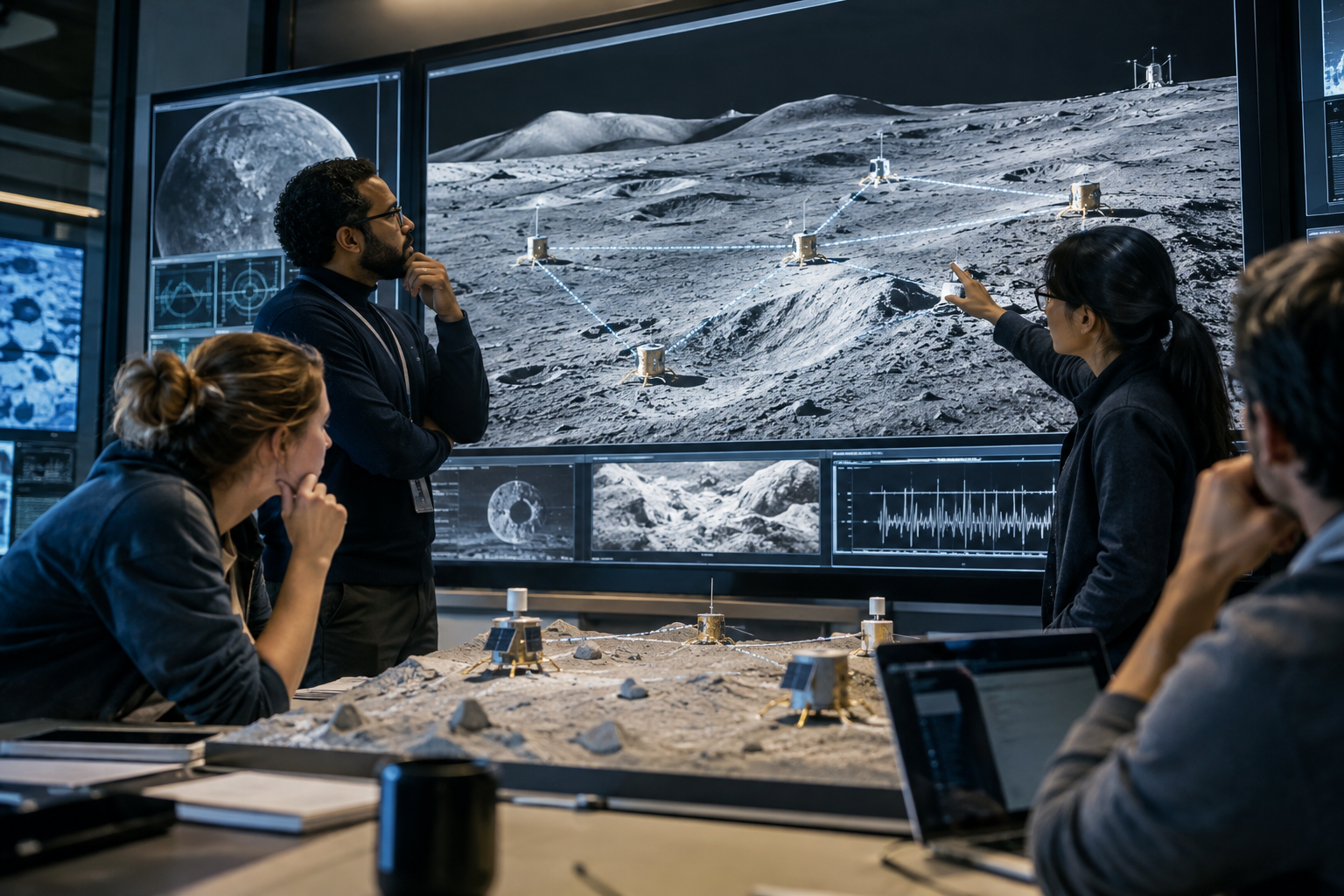
A simulated mission study is making an economic as well as a scientific case for spreading lunar instruments across the surface and keeping them listening. Rather than concentrate resources in a single, more elaborate station, the fictional exercise compares that approach with a network of 12 modest instruments. Its central finding is conditional: geographically separated sensors can distinguish overlapping signals more effectively because they record different arrival times, provided their clocks remain sufficiently well aligned.
The network has an illustrative budget of $390 million and an intended observing period of 30 months. For the financial comparison, the more elaborate station is assigned a hypothetical cost of $450 million over the same observing window, making the network $60 million, or 13.3 per cent, cheaper. These are planning assumptions in a fictional design exercise, not procurement estimates or approved spending. The question is whether sustained, distributed measurement offers more scientific value for each dollar committed—and whether coordination costs could consume the apparent saving.
The distinction matters because the exercise is a design comparison, not a discovery about the Moon. Its conclusions depend on assumptions about instrument sensitivity, placement and the lunar background environment. A network that performs well against one simulated mix of signals and noise might fare differently under another. Nor does distributing equipment automatically create a superior observatory. The instruments must work together closely enough for researchers to identify which recordings belong to the same event, rather than merely accumulate a larger collection of ambiguous measurements.
Read more: A model compact puts public contracts at the centre of democratic renewal
The scientific advantage comes from geometry. A signal reaching one instrument before another provides information that a measurement from a single location cannot supply on its own. Comparing those differences across the network can help separate events that overlap in an individual recording. Longer observation also creates more opportunities to compare recurring patterns and investigate unusual ones. But neither benefit is guaranteed: additional months of poorly calibrated measurements could leave researchers with more data without a corresponding improvement in confidence.
An illustrative allocation of the network’s $390 million budget puts $156 million into instruments and local support equipment, equivalent to 40 per cent of the total. Delivery and deployment account for $117 million, or 30 per cent. Calibration, communications and observing support receive $78 million, or 20 per cent, while the remaining $39 million is held as a contingency reserve. The allocation expresses the study’s central trade-off: resources go towards keeping separate instruments scientifically coherent rather than adding another sensor type and increasing the range of measurements attempted.
Spread across the intended 30-month observing period, the network’s total budget amounts to $13 million per planned observing month, compared with $15 million for the single-station alternative. That is a way to compare total mission costs, not a forecast of monthly cash expenditure: hardware and deployment spending would occur before much of the observing work. It also says nothing by itself about scientific productivity. A cheaper month is not better value if unreliable timing prevents useful comparisons among instruments or if the assumed placement proves impractical.
Read more: Border reform moves from tariff schedules to the loading bay
Coordination is therefore the network’s principal vulnerability and a potentially significant source of cost overruns. In one illustrative financial sensitivity test, a 15 per cent increase in the $78 million calibration, communications and observing-support allocation would add $11.7 million. That would consume 30 per cent of the contingency reserve, leaving $27.3 million for other problems without increasing the headline budget. The calculation does not predict an overrun. It shows how a seemingly narrow technical weakness could compete with equipment failures or deployment difficulties for the same financial cushion.
The strongest argument for the network is that scientific ambition need not reside entirely in more elaborate hardware. Multiple observing positions and a longer run of measurements could make relatively modest instruments more useful collectively than their specifications suggest individually. Dispersal could also limit the consequences of losing one location. Yet the value of that resilience depends on which instrument fails: losing a strategically placed sensor could damage the network’s geometry more severely than a simple count of surviving units would indicate.
The competing case favours concentration. A single elaborate station could reduce the need to synchronise geographically separated equipment and direct more effort towards measurements made at one site. Its supporters in this design debate would need to show that those capabilities compensate for the missing arrival-time comparisons. Equally, the network’s case cannot rest on its lower illustrative price alone. The simulated advantage must survive less favourable assumptions about sensitivity, background conditions and the practical cost of maintaining coordination.
The next step for such a study would be to test those assumptions systematically before treating either architecture as preferable. That means varying instrument placement, degrading timing accuracy and examining interruptions across the full 30-month window. Financial comparisons would also need matching definitions of delivery, support and contingency costs. Until then, the exercise offers a proposition rather than a mission recommendation: listening longer, from several places, may be worth more than making one landing more elaborate.