Art · Art
Bagri Foundation opens first London exhibition with Zezegmaa’s church installation
A 27-metre batik suspended in St Cyprian’s church introduces the foundation’s Springboard programme and marks the Mongolian artist’s UK exhibition debut.
By Calla Brenmoor · 3 min read
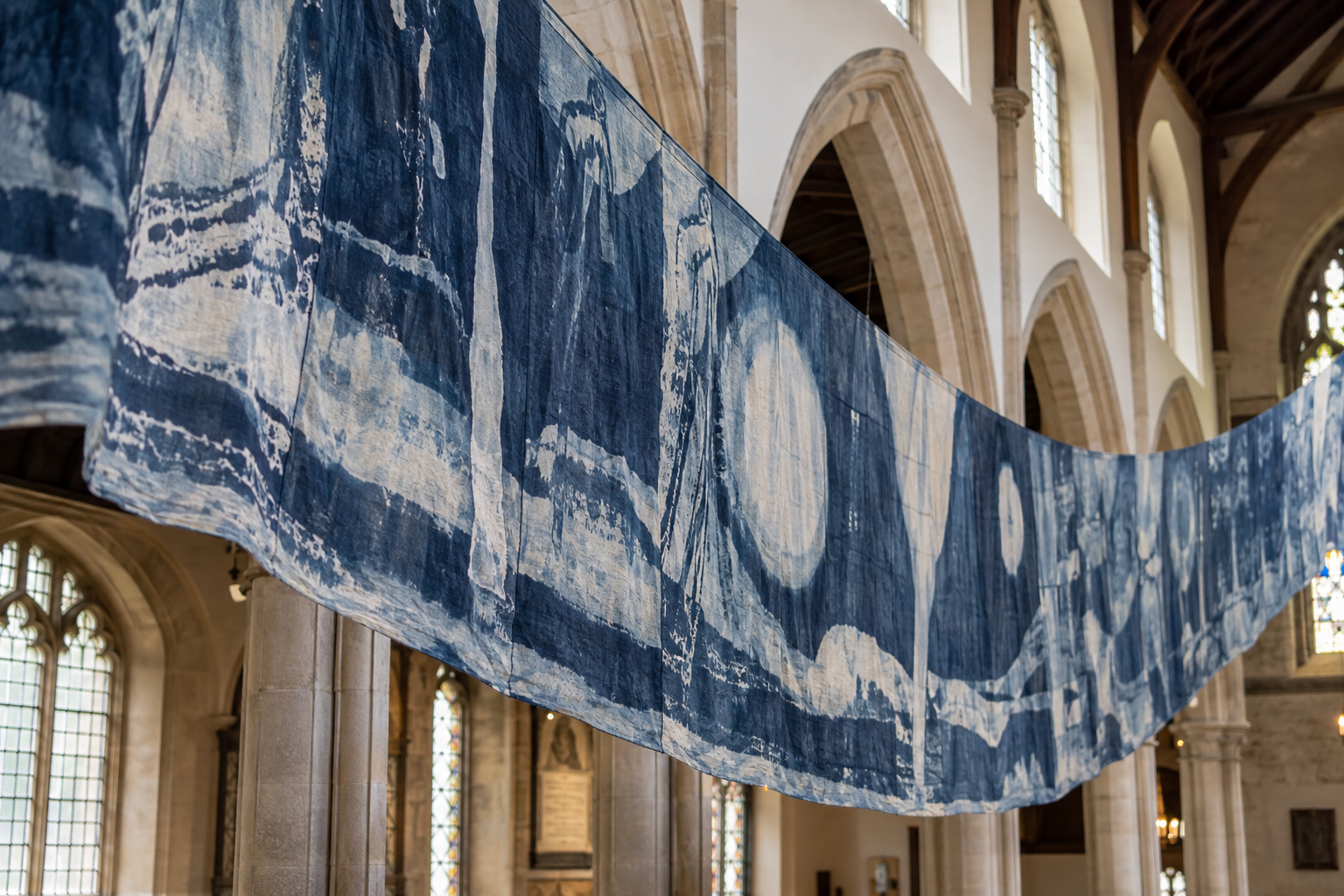
The Bagri Foundation has opened its first London exhibition in a Gothic church in Marylebone, presenting a large-scale batik installation by the Mongolian artist Nomin Zezegmaa. Suspended from the ceiling of St Cyprian’s, the work brings the foundation’s new exhibition programme into an ornate architectural setting. For Zezegmaa, whose practice draws on Mongol cosmology, landscapes and ancestral memory, the aim was to introduce her work without competing with the building’s architecture.
The exhibition, You Who Sing Into Existence, opened the weekend before 14 October and runs until 24 October 2026. Its centrepiece is a 27-metre batik, installed in a church a 15-minute walk from Frieze London, near Regent’s Park. It is both Zezegmaa’s first UK show and the inaugural exhibition of Springboard, a curatorial initiative intended to give Asian artists their first UK institutional presentation each year. The project therefore combines an individual artist’s British debut with a new recurring programme from the London-based foundation.
Chelsea Pettitt, the foundation’s director, has also curated the exhibition. Her account of the installation emphasises the practical achievement of placing such a substantial textile overhead in this particular setting. “I still cannot believe we managed to hang a 27-metre batik from the ceiling of this hidden London Gothic church,” she says. That dimension conveys the scale of the undertaking, while the artist’s account emphasises how subtly she hoped the works would sit within the space.
Read more: North Korea reports tests of two submarine-launched cruise missile types
Zezegmaa describes a different, complementary priority: allowing the church’s architecture to retain its presence. “Rather than fighting and screaming for attention visually, I hoped for the works to be like subtle interventions that do not disrupt the architectural environment, but add a layer to it,” she says. Her intention places restraint alongside physical scale. The suspended work is substantial, but her stated aim was for the works to be additions to their surroundings rather than rivals to them.
That distinction gives the venue a role beyond simply accommodating the installation. St Cyprian’s ornate Gothic architecture was something Zezegmaa explicitly considered in deciding how she wanted the works to relate to their setting. The church is therefore part of the exhibition’s artistic context, not merely its London address. Pettitt’s emphasis on the achievement of hanging the batik and Zezegmaa’s emphasis on visual sensitivity offer two ways of understanding the same installation: through the demands of its presentation and through its intended relationship with the building.
Born in Germany and based in Ulaanbaatar, Mongolia’s capital, Zezegmaa brings a practice rooted in Mongol cosmology, landscapes and ancestral memory to this UK debut. Those concerns provide the context for her practice, alongside her stated attention to the church’s Gothic architecture in this exhibition. The presentation brings these elements into proximity: an artist working from Mongolia, a practice attentive to ancestral memory, and a London religious building whose existing visual character she has chosen to respect rather than contest.
Read more: Japan denies espionage after Russia arrests Japanese journalist
For the Bagri Foundation, established in 1990, Springboard adds an exhibition initiative to a remit already centred on widening international awareness of Asian art and culture. The foundation supports Asian artists and exhibitions through grants and partnerships. Its inaugural London show extends that activity into a programme organised around individual UK institutional debuts. The continuity lies in the focus on Asian cultural work; the new element is the annual exhibition framework, with Zezegmaa’s presentation establishing the programme’s first example.
The figures attached to the launch describe different aspects of that framework. The 27-metre dimension concerns the physical scale of the opening installation, while the annual schedule concerns the intended rhythm of Springboard beyond this first presentation. The 15-minute walking distance from Frieze London places the church close to the fair during its run. These details establish the installation’s scale, the programme’s intended frequency and the venue’s location, rather than documenting audience response to the exhibition.
Its timing also places the debut within the Frieze period. The installation remains open into the week following the fair, closing on 24 October. That schedule gives the church presentation a run extending beyond Frieze, while its Marylebone location keeps it within walking distance. For a programme devoted to first UK institutional shows, the conjunction of timing and place provides an immediate setting for the launch, even as the artist’s stated concerns remain focused on the work’s relationship with the architecture.
Springboard’s stated remit is to offer Asian artists their first UK institutional exhibition on an annual basis. For now, Zezegmaa’s installation supplies the programme’s opening statement: substantial in dimension, but conceived with attention to an already elaborate setting. Until 24 October, the foundation’s move into exhibitions can be seen through that balance between ambition and restraint, with the suspended batik introducing both an artist to UK exhibition audiences and a new curatorial strand to the organisation’s work.