France · World
Carrefour warning adds business pressure to France’s cost-of-living unrest
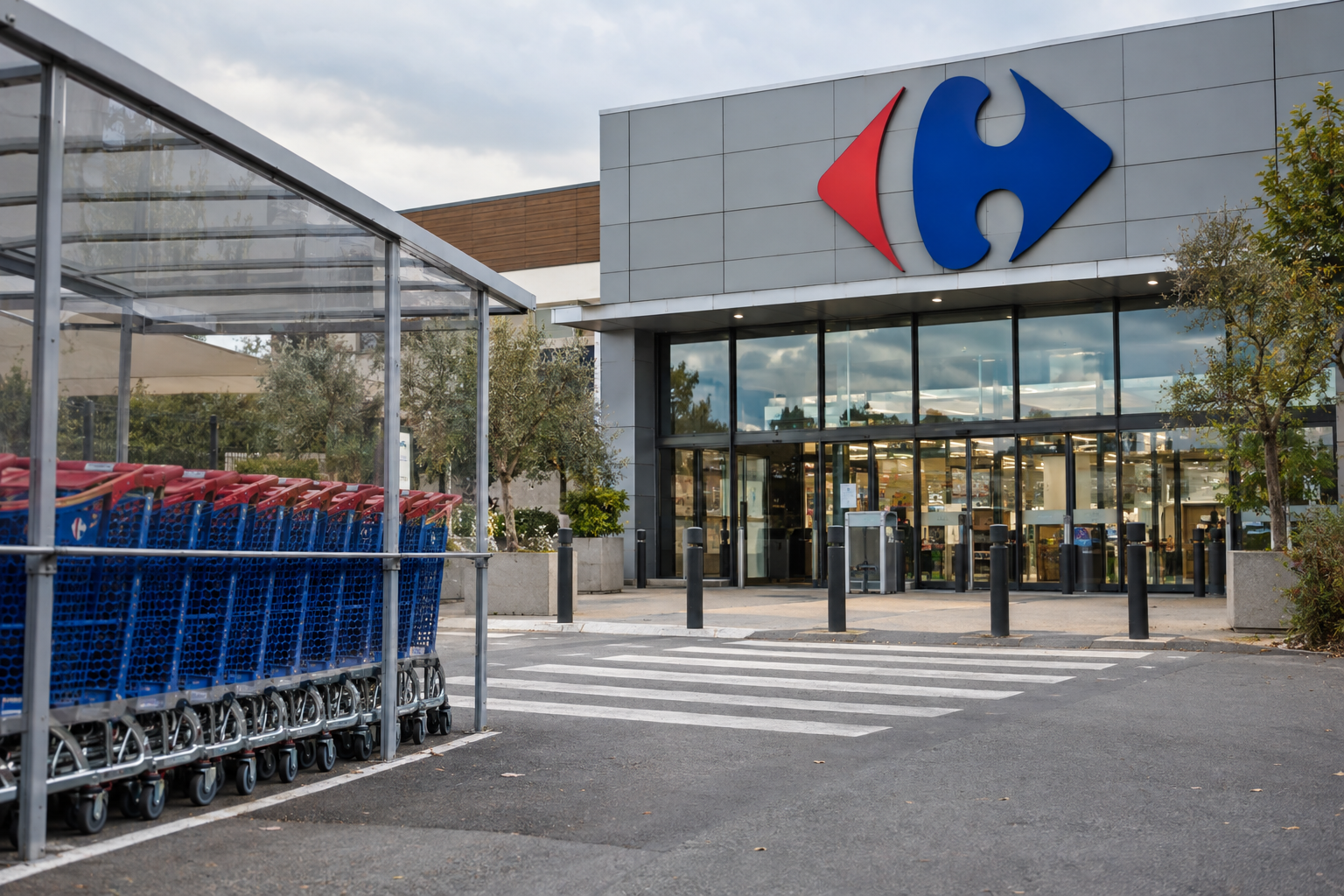
Carrefour shares fell more than 13% after a profit warning linked to unrest in France, as President Emmanuel Macron accused foreign leaders of basing their comments on fabricated AI videos.
By Ilan Corven · 4 min read
France’s cost-of-living unrest brought renewed pressure on business and government on Wednesday, as Carrefour shares fell sharply after the supermarket group lowered its profit outlook and President Emmanuel Macron challenged foreign accounts of the violence. The developments highlighted business and political pressures surrounding demonstrations that drew peaceful crowds nationwide but were overshadowed by rioting and looting, with further protests planned for Saturday and the government preparing a stronger security response.
Carrefour shares dropped more than 13% on October 21 after the company reduced its full-year profit forecast, citing an “unprecedented situation in France”. The warning came after more than half a million people demonstrated peacefully against rising living costs on Saturday. Those rallies followed four weeks of student protests that had shut many schools. Together, the company’s warning and the scale of mobilisation underscored the pressure surrounding an unresolved cost-of-living dispute.
The share-price decline followed Carrefour’s revised assessment, but it should not be confused with a measure of the damage caused by the unrest. The figure describes the fall in the company’s stock, not a reduction in sales or the size of its profit downgrade. Carrefour’s decision to lower its annual forecast nevertheless brought the commercial implications of the disruption into focus alongside the government’s response to the demonstrations.
Read more: Trump releases Northeast heating oil with U.S. average at $6.14 a gallon
The underlying grievance remains the rising cost of living, the issue that brought people onto the streets across France. The distinction between those demonstrations and the violence around them is important: more than half a million people marched peacefully, while rioting and looting occurred on the sidelines. Treating the entire mobilisation as a security disturbance would obscure the economic demands behind it, just as focusing only on those demands would overlook the violence confronting the authorities.
The protests also have a longer backdrop than the events of October 17. Student mobilisation had already continued for four weeks, disrupting schools across the country before the nationwide cost-of-living marches. That sequence places the latest unrest within a sustained period of protest rather than an isolated weekend confrontation. With another round of demonstrations approaching, the government faces the task of preventing further violence while the grievances that prompted the marches remain central to the mobilisation.
Speaking to reporters in Doha on Wednesday after a Gulf trip, Macron said fabricated images had distorted foreign reactions to the unrest. He accused unnamed foreign powers of spreading false material and said leaders campaigning in elections had repeated AI-generated content, at times credulously. His criticism concerned both the images themselves and the political conclusions drawn from them, particularly claims that France’s disturbances amounted to an invasion by migrants or Islamist extremists.
Read more: U.S. campaigns spend $137 million on AI-made ads ahead of midterms
Macron drew a distinction between manipulation of information about the unrest and foreign involvement in the events themselves. He said he did not regard what had happened in France over the weekend as “foreign interference”. His accusation was instead that fabricated depictions of violence had circulated and influenced commentary abroad. That qualification matters: the president was alleging distortion of the public account, not attributing the outbreak of rioting to an externally directed operation.
The president did not identify US President Donald Trump or Israeli Prime Minister Benjamin Netanyahu by name. Both, however, had made comments linking the unrest to issues other than living costs. Netanyahu said on Tuesday that France had been hit by an “invasion of extremist Islam”. Trump linked the events to immigration. Macron rejected the depiction of France as overrun by migrants and Islamists, saying AI-generated images had portrayed scenes that had not occurred in the country.
The competing accounts place different explanations at the centre of the crisis. The demonstrations were organised around the rising cost of living; Trump’s and Netanyahu’s comments emphasised immigration and extremist Islam. Macron’s response sought to separate those claims from the events on the ground. His denunciation of fabricated imagery did not amount to a denial that violence had taken place: his government was simultaneously preparing a more forceful security operation in response to the rioting.
Electoral politics formed part of Macron’s explanation for the international criticism. Trump faces important US midterm elections in November, while Netanyahu faces an election this month. Macron said leaders seeking votes had used the material to attack France. That was the French president’s account of their motivations, rather than an explanation offered by the leaders themselves. It added a diplomatic dispute over political messaging to the domestic arguments about protest, public order and economic pressure.
Trump also praised Marine Le Pen as a “conservative voice”. Le Pen, the far-right frontrunner in France’s presidential election next year, thus featured in the US president’s commentary on the unrest. His praise added a French electoral dimension to the exchange, although Macron’s remarks in Doha did not name either Trump or Netanyahu. The president instead framed his criticism broadly around foreign leaders and the use of false images in their responses to France.
At home, the government has acknowledged shortcomings in its initial handling of the violence and promised a substantially expanded security operation for Saturday. Troops are expected to be deployed as part of the stronger response. Macron said people seeking to create disorder in city centres would be stopped. Those commitments put the authorities’ operational preparations alongside the president’s effort to challenge misleading portrayals of the earlier unrest.
Macron said he would meet intelligence officials, Prime Minister Lecornu and other ministers on Thursday to obtain a detailed account of the October 17 disturbances. The review comes before the next demonstrations, giving the government an immediate opportunity to examine its response and preparations. It also distinguishes the assessment still being assembled by French officials from the sweeping interpretations already advanced abroad, which Macron said had been influenced by images of events that never happened.
For Carrefour, the central development remains the lowered full-year profit forecast and the ensuing market reaction. For the government, the next steps are the Thursday review and Saturday’s security operation. Those separate tests now sit within the same period of unrest: a major retailer has revised its outlook, protesters are preparing to return to the streets, and the president is defending both the state’s handling of violence and the accuracy of the international account.