Art · Art
Lucas Museum gives murals a central place in its account of storytelling
Works by Banksy and preparatory drawings for Judy Baca’s community-led mural bring public narratives into galleries built to accommodate their scale.
By Calla Brenmoor · 3 min read
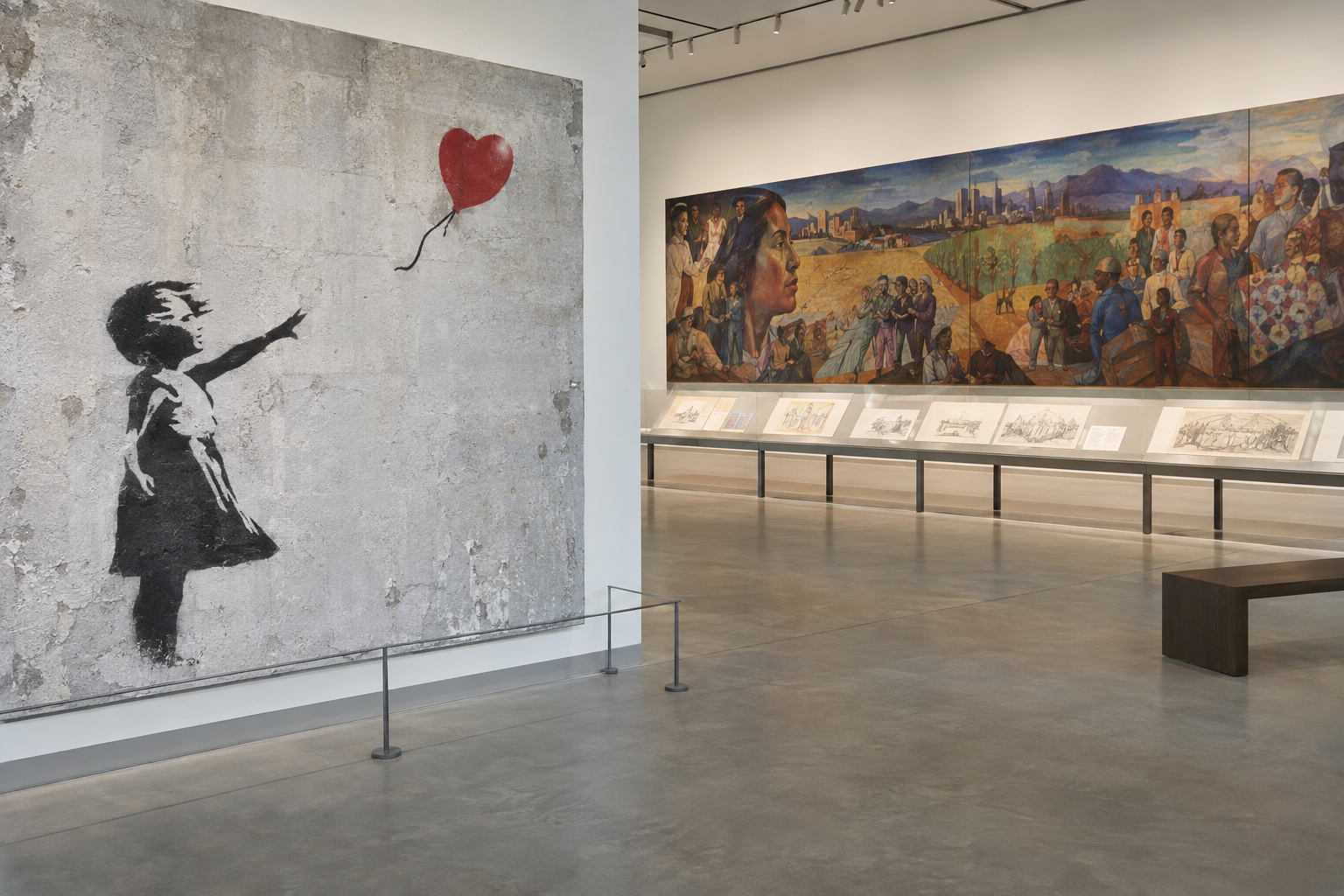
The Lucas Museum of Narrative Art is giving murals a prominent place in its galleries, bringing works by Banksy together with images and preparatory studies by artists including Judy Baca and Diego Rivera. The displays put art associated with streets and community settings at the centre of the museum’s approach to storytelling, while raising questions about how much of that public context accompanies the works indoors.
The scale is substantial: a fifth-floor gallery has 25ft-high ceilings, and an adjoining gallery contains 12 Banksy works. Some of the Banksy pieces were reproduced in the artist’s studio, while two are on loan. Alongside murals, the collection includes preparatory renderings, drawings and paintings, allowing the museum to present both large images and the work that precedes them. Artists represented in these displays also include John Biggers, Dean Cornwell and Charles White.
For senior curator Ryan Linkof, murals belong within the museum’s wider interest in illustration, understood not simply as a professional discipline but as a way to communicate stories. He describes murals as a form particularly suited to presenting history and social issues directly to a broad audience. That rationale gives the displays a purpose beyond filling large walls: the museum is treating mural-making as a narrative practice, with preparatory studies part of the account rather than merely supplementary objects.
Read more: Palestinian artists’ lives frame a ceasefire anniversary podcast
Banksy’s presence is especially notable because the anonymous British artist has generally stayed away from museum exhibitions. Details of his contribution were restricted so tightly that most museum staff learned what the spaces would contain only at the media preview. Chief executive Tracey Bates could not explain how the works had reached the institution. She characterised the relationship instead through George Lucas’s longstanding support for muralists and enthusiasm for Banksy, calling the artist “an incredibly elusive artist”.
The institutional setting does not, however, bring extensive interpretation. Banksy’s works have brief labels offering little or no background, an approach found across much of the museum. Among the most recognisable images is Girl with Balloon, which began appearing as stencils on walls around London in 2002. Its display brings a familiar street image into the gallery, but the sparse accompanying text leaves limited scope for visitors to understand its original settings or the circumstances of its presentation here.
That restraint creates a tension with the museum’s emphasis on murals as public communication. Linkof’s account stresses their capacity to make social concerns legible, yet an image’s narrative and the history of its production are not necessarily the same thing. The Banksy selection makes that distinction particularly apparent: visitors encounter works by an artist who has long worked anonymously, while the museum offers little explanation of how the unusual institutional collaboration came about. Bates’s description provides a relationship, rather than a detailed account of the arrangements.
Read more: Trump and Putin agree to release Russian diesel as fuel-price pressure mounts
Elsewhere, preparatory drawings give a different point of entry into mural practice. Opposite the Rivera mural are colour studies for Baca’s The Great Wall of Los Angeles, a project dating from 1974 that presents the city’s history along the Tujunga Wash in the San Fernando Valley. Baca conceived the work, and students and community members carried it out during summers. The studies place the development of that collective undertaking within the museum, rather than presenting muralism solely through finished, monumental images.
Baca has described her intention as creating a California history that included ethnic communities, women and minorities largely invisible in conventional textbook narratives. That purpose connects closely with Linkof’s emphasis on murals as a direct means of expressing social concerns. It also supplies a concrete example of what public storytelling can involve: not only an image available to a broad audience, but a historical account shaped around people whose experiences its creator considered insufficiently represented, and made with community participation.
The project is still being expanded. In 2021, the Mellon Foundation awarded Baca and her team a $5m grant to extend both the mural and its historical coverage, taking the narrative from the 1960s to 2019. Completion of the extension is due in 2028, in time for the summer Olympic Games. Those dates give the museum’s preparatory drawings an ongoing context: they relate to a work begun in 1974 whose scope is still being expanded, rather than to a closed episode in mural history.
Taken together, the displays offer distinct ways of bringing public-facing art into a museum: Banksy’s unusual institutional appearance, large-scale murals and the studies behind a community history still in progress. The gallery dimensions provide room for the images, while the drawings broaden the account of their making. A planned milestone lies outside the institution, with the completion of Baca’s extension due in 2028—a reminder that the stories represented on the museum’s walls also continue beyond them.