Art · Art
Palestinian artists’ lives frame a ceasefire anniversary podcast
Ben Luke’s latest episode considers trauma, grief and displacement among four Gazan artists alongside London presentations of Robert Ryman and Katherine Hubbard.
By Calla Brenmoor · 3 min read
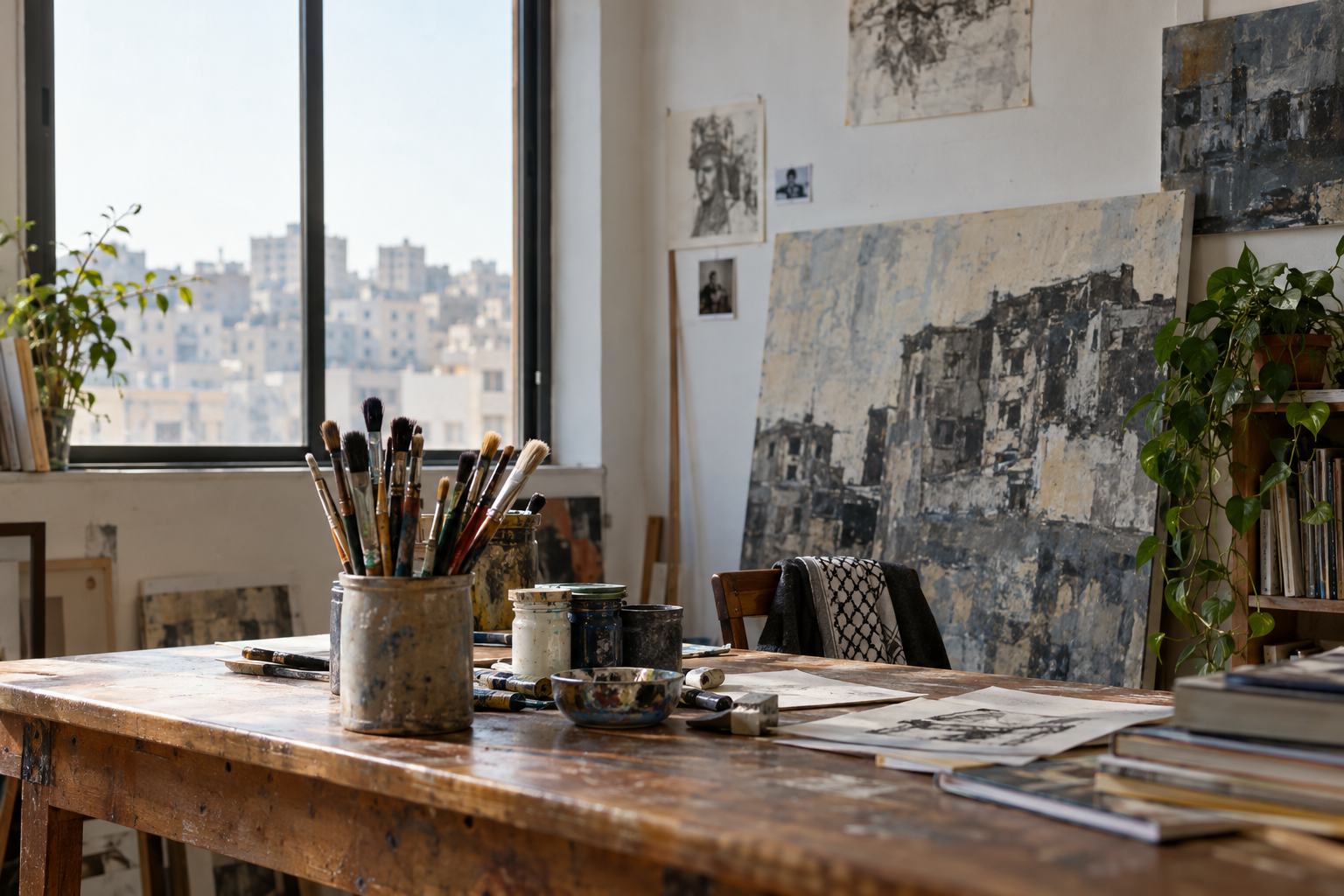
A year after the Gaza ceasefire, the lives of Palestinian artists provide the starting point for an arts podcast examining the anniversary amid continuing bloodshed. In the episode dated 9 October 2026, Ben Luke hears about recent conversations with four Gazan artists whose experiences encompass trauma, grief and displacement. Their circumstances highlight the distance between a ceasefire and personal security in an edition that also turns to a survey exhibition, illness and memory in London.
The central figure accompanying that anniversary is stark: the United Nations Human Rights Office said in figures released in August 2026 that more than 1,200 Palestinians had been killed by Israel since October 2025. The four artists discussed in the programme have experienced different degrees of trauma, grief and displacement. Together, those elements establish two distinct scales for the discussion: an aggregate account of deaths since the previous October and a closer examination of individual lives within Gaza’s artistic community.
The timing of the figures matters. Released in August, they do not constitute a count taken at the first anniversary itself. They nevertheless establish that the ceasefire did not end the killing. For an arts programme, that distinction provides essential context: the anniversary cannot be treated simply as the beginning of an uninterrupted period of recovery. The artists’ circumstances instead have to be considered against both the ceasefire and the violence that has continued since it began.
Read more: Lucas Museum gives murals a central place in its account of storytelling
The account of four artists also calls for care in interpreting the scope of the discussion. Their differing experiences do not amount to a single, uniform story of artistic life in Gaza. Trauma, grief and displacement are related but not interchangeable conditions, and the description of different levels of each leaves room for those distinctions. The conversations concern particular lives and should not be taken as a comprehensive account of Palestinian artists’ circumstances.
That subject gives the Gaza segment its significance within an art programme. The discussion brings attention to artists’ lives, not simply to the objects they make. Here, the anniversary supplies a point at which to return to their circumstances, rather than evidence that those circumstances have been resolved. A calendar milestone and a lived transition need not coincide; the continuing deaths reported by the UN make that tension especially relevant to the discussion.
The episode also broadens its field through Luke’s visit to a new survey of Robert Ryman at the Barbican in London and a conversation with the US artist Katherine Hubbard. The three strands offer different entry points into an arts broadcast: an account of artists’ circumstances in Gaza, an encounter with a survey exhibition, and an artist’s discussion of an installation. Their inclusion in one edition creates a contrast in subject and setting, but need not be read as making the experiences behind them equivalent.
Read more: Trump and Putin agree to release Russian diesel as fuel-price pressure mounts
Hubbard’s contribution concerns The Great Room, a work dated 2020-ongoing whose latest iteration was unveiled during the week of the episode at Studio Voltaire in London. Selected as the episode’s Work of the Week, the installation explores her mother’s illness and memory loss. Its continuing date range is significant to how the work is presented: this is an ongoing project with a new iteration, rather than a work identified solely with its current exhibition. The London presentation is also dated 2026.
Personal experience thus enters the episode through more than one route, although the distinctions remain important. Hubbard’s discussion centres on her mother’s illness and memory loss; the Gaza segment concerns artists facing different levels of trauma, grief and displacement. It would be reductive to collapse those subjects into a shared account of suffering. The connection is that both strands bring lived experience into an arts discussion, with Hubbard’s installation explicitly exploring a personal subject and the Gaza conversations addressing artists’ circumstances.
The London exhibitions give the episode a forward-looking calendar as well as its anniversary focus. Robert Ryman: The Real Thing at the Barbican Art Gallery runs from 9 October 2026 to 28 February 2027. Katherine Hubbard: The Great Room remains at Studio Voltaire until 10 January 2027. Those dates allow audiences to pursue the exhibition strands beyond the broadcast, with the Ryman survey and Hubbard installation offering separate opportunities to consider the works discussed in the programme.
For the Gaza strand, the anniversary leaves a different question open: how to understand artists’ lives when a ceasefire has not ended bloodshed. The episode returns to four artists whose experiences differ, set beside the wider mortality figures released by the UN. That combination makes the anniversary less a conclusion than a point of reassessment, keeping attention on individual circumstances and providing no basis to assume that the passage of a year itself demonstrates recovery.