Chip packaging · Technology
The next computing bottleneck may sit around the processor
Demo journalism: An invented hardware programme explores why packaging and testing can constrain the supply of advanced computing systems.
By Rian Keswicke · 4 min read
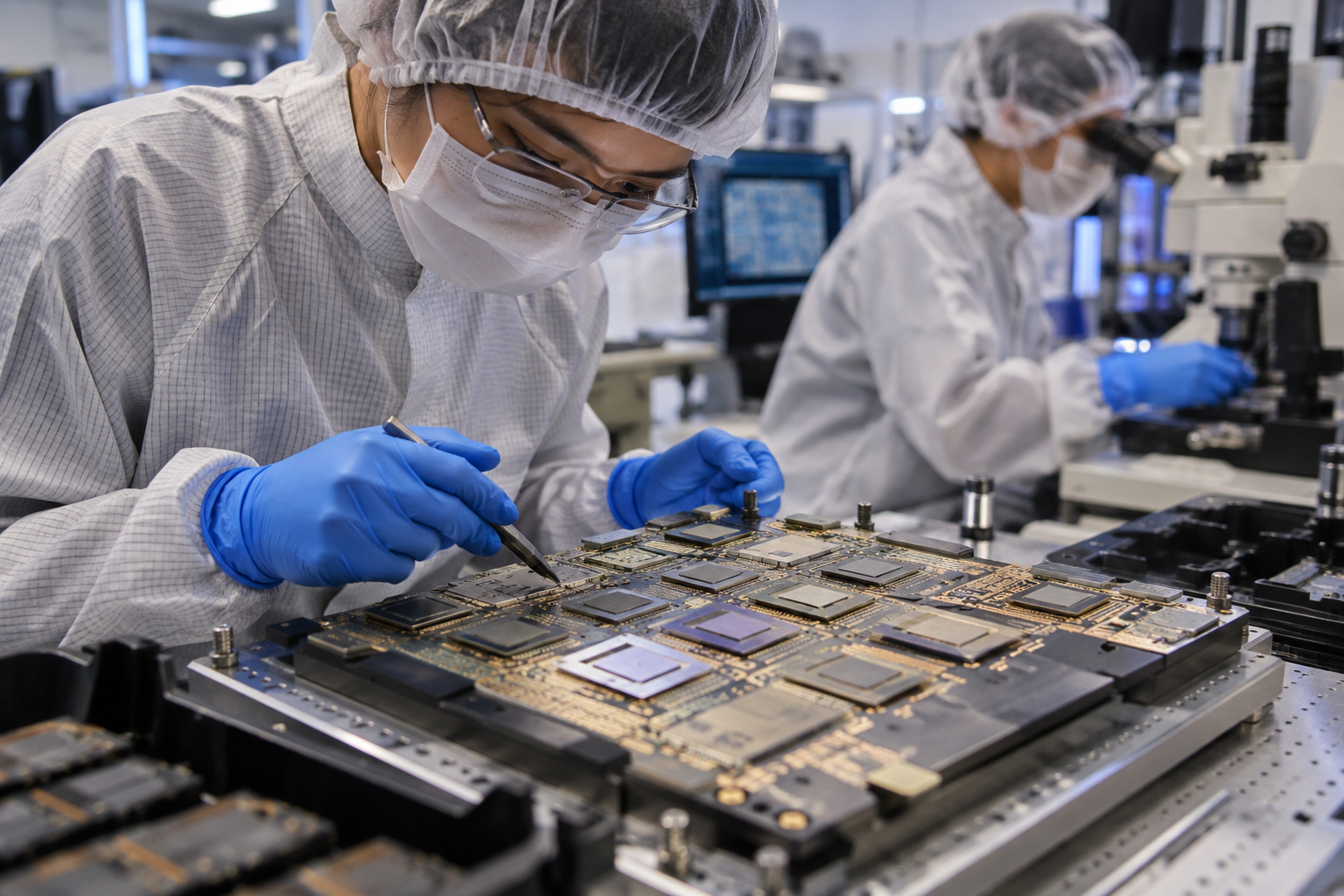
The next constraint on advanced computing may emerge not in the fabrication plants that produce processors, but in the less conspicuous operations that connect them to memory and turn them into working modules. Fictional chip assembler Ostrand Circuits has designed a demonstration programme around that possibility, examining how packaging defects, inspection capacity and qualification delays could limit deliveries even when enough silicon is available. Its central proposition is that a processor reservation offers buyers little protection if downstream assembly cannot produce a dependable, usable computing module.
The illustrative programme envisages a $460 million expansion, with 35% of spending, or $161 million, assigned to inspection and testing equipment. Its financial model assumes an initial usable-package yield of 76%, rising to 88% after process adjustments—a gain of 12 percentage points. Those figures are scenario inputs, not reported manufacturing results. Together, they frame the programme’s central economic question: whether investing in the machinery that detects and diagnoses defects can deliver more usable computing capacity than simply increasing the volume entering assembly.
Packaging sits between chip fabrication and the delivery of a module ready for installation in a computing system. It provides the connections through which processors and memory exchange data, while helping manage power delivery and heat. A flaw in those connections can prevent an otherwise functional collection of components from meeting its specification. Ostrand’s fictional exercise therefore treats packaging as a production stage with its own capacity limits and learning curve, rather than as a routine finishing operation whose output automatically keeps pace with wafer supply.
Read more: Smaller AI systems compete on the cost of being checked
The remaining $299 million in the demonstration budget would be split between $207 million for assembly equipment and $92 million for facilities and supporting infrastructure, equivalent to 45% and 20% of total spending respectively. That allocation makes testing a substantial capital commitment rather than an incidental expense. Under the scenario, annual assembly starts would reach 100,000 packages, compared with a baseline of 80,000—a 25% increase. Yet that expansion in gross capacity would not, by itself, establish how many modules customers could actually use or when they would become available.
At the assumed initial yield of 76%, those 100,000 annual starts would produce 76,000 usable packages. Raising yield to 88% would lift usable output to 88,000 without increasing starts, an improvement of about 15.8%. The number failing to qualify as usable would fall from 24,000 to 12,000, halving the unsuccessful share of production. These calculations illustrate why relatively small improvements across complex connections can have an outsized effect on delivered capacity. They do not establish that Ostrand could achieve the higher yield, or that every unsuccessful package would represent an unrecoverable loss.
The same arithmetic changes the apparent cost of production. Assuming, solely for this model, an annual assembly-and-test operating cost of $120 million at either yield, the cost per usable package would decline from about $1,579 to $1,364, a reduction of 13.6%. This narrow measure excludes processors, memory, financing and depreciation; it is not a forecast of total module cost or selling prices. It nevertheless shows how spreading a largely fixed operating budget across more qualified output can improve economics even before any additional machinery is installed.
Read more: A model compact puts public contracts at the centre of democratic renewal
There is a competing investment case. If low yield reflects a temporary learning problem, committing $161 million to inspection and testing could leave expensive equipment underused once processes stabilise. Additional assembly machines, supplier improvements or simpler package designs might offer better returns in some circumstances. Conversely, testing that identifies a recurring fault early could prevent the same defect from being repeated across a larger production run. The relevant comparison is therefore not merely equipment prices, but the cost of undetected failures against the cost and speed of finding them.
For buyers, the distinction would affect procurement as much as manufacturing. In a further scenario assumption, a qualification period of 16 weeks rather than a planning target of 12 weeks would add one-third to the time needed for approval. A processor allocation secured months earlier would not eliminate that delay. Customers seeking supply resilience would need visibility into packaging slots, test availability and qualification milestones, alongside wafer commitments. They would also need to distinguish nominal assembly capacity from demonstrated usable output, particularly when evaluating a supplier that is introducing a more complex module.
What comes next in the demonstration is a question of evidence, not a claim of commercial success. The programme would need to test whether process adjustments can move usable-package yield from 76% towards 88%, and whether inspection capacity can support that improvement without becoming a bottleneck itself. Spending decisions would then depend on the source of the remaining failures and the time required to qualify output. For Ostrand’s invented programme, the lesson is conditional but clear: more wafers can expand potential supply, while packaging and testing determine how much of that potential reaches a finished system.