Trade · Opinion
America’s 100% tariff does not settle the Chinese EV question
Rick Lazio warns about China’s EV rise as a tariff imposed in 2024 largely shields Americans from direct competition with Chinese automakers.
By Editorial Board · 4 min read
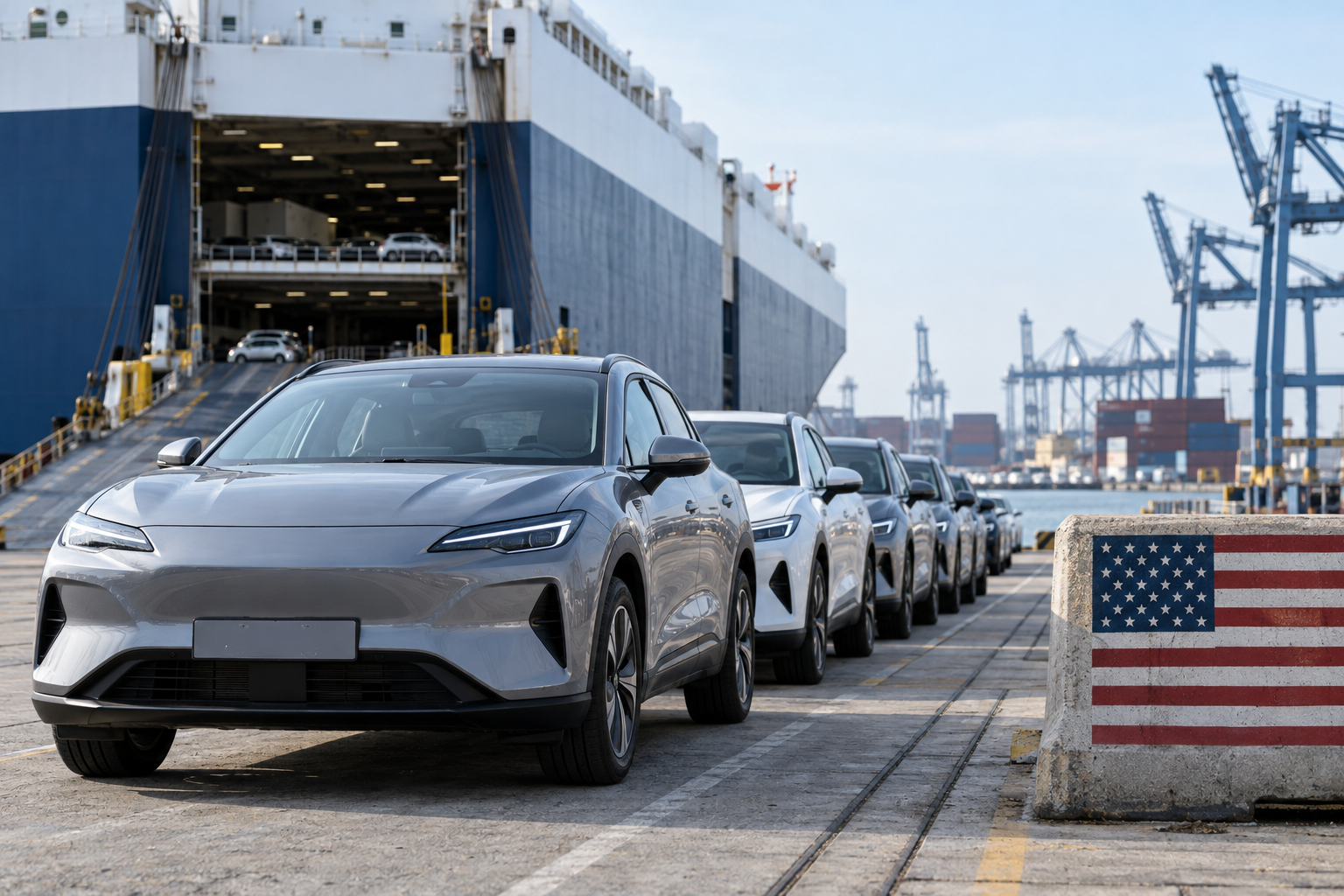
A trade barrier can keep a competitor out without resolving the question of how strong that competitor has become. That distinction provides a useful way to assess Rick Lazio’s warning about Chinese electric vehicles. His warning deserves consideration without being treated as proof that American automakers are destined to fall behind. Restricting access to a market and securing a competitive advantage are different objectives. Success at the former does not, by itself, establish success at the latter.
The central policy fact is substantial: the United States imposed a 100% Section 301 tariff on Chinese electric vehicles in 2024. Lazio describes the resulting barrier as effectively closing the American market to those vehicles. Americans have consequently been largely shielded from direct competition with Chinese automakers. That makes the tariff essential context for interpreting the competitive landscape: limited direct competition from Chinese automakers cannot simply be read as evidence that American alternatives have prevailed on their merits.
Lazio frames his concern through a historical warning, arguing that America has previously lost an automotive contest and should take China’s EV advance seriously. The supplied excerpt does not identify the earlier episode or provide the evidence needed to compare it with electric vehicles today. The analogy therefore has limits as presented here. Its useful contribution is to raise a question about complacency, not to establish that history will repeat itself or that the same industrial circumstances now apply.
Read more: Vietnam’s growth ambitions confront a capital constraint
A counterargument to concern about the competitive threat begins with the tariff’s immediate function. If the objective is to prevent direct competition from Chinese electric vehicles in the United States, Lazio’s own description suggests that the restriction has largely accomplished that narrow task. This is not an inconsequential distinction: current access to customers matters separately from a manufacturer’s potential strength. The supplied excerpt does not identify a tariff advocate offering a detailed defence, however, so this policy logic should not be presented as an attributed statement of official intent.
Taking Lazio’s warning seriously does not require denying that immediate effect. One question it raises is whether insulation from competition could encourage an overly comfortable assessment of the underlying challenge. A manufacturer excluded by a tariff is not necessarily a manufacturer that has failed to develop attractive products. Equally, exclusion does not prove that its products would outperform domestic alternatives. The barrier limits what can be inferred from the market outcome; it does not answer the product question in either direction.
The 100% figure is therefore powerful but incomplete evidence. It describes the tariff rate, not a measured difference in vehicle quality, production efficiency or commercial appeal. The supplied excerpt contains no comparative prices, sales figures, costs or measures of vehicle performance. Without such evidence, it would be unjustified to translate Lazio’s concern into a numerical claim about China’s advantage. It would be just as unjustified to use the tariff’s apparent effectiveness as a numerical measure of American manufacturers’ competitiveness.
Read more: U.S. reduces embassy staffing as warnings of Iranian threats intensify
This separates two propositions that can otherwise become entangled. One concerns whether a restriction can shelter a domestic market; the other concerns whether that shelter makes domestic producers stronger. The first has support in Lazio’s description of American exposure to Chinese competition. The second requires evidence that is not provided in the excerpt. A balanced assessment must leave room for protection to serve a useful purpose while also recognising that a protected position is not the same thing as a durable industrial lead.
The unresolved issue is what happens within that protected position. If shelter allows manufacturers to improve their products and competitiveness, the case for viewing it as strategically useful would be stronger. If it merely reduces the pressure to improve, Lazio’s warning would carry greater force. Neither outcome is established here. These are competing tests of the policy rather than reported developments, and treating them as such avoids assigning either benefits or failures to the tariff without supporting evidence.
The same discipline applies to the question of changing the restriction. Concern about Chinese competition does not automatically establish that the tariff should be removed, reduced or retained indefinitely. The supplied material pairs Lazio’s warning about China’s EV rise with his description of the tariff’s shielding effect. It should not be expanded into a specific trade-policy prescription that the excerpt does not supply. Nor does the available material establish what a different tariff would mean for American producers or buyers. Those consequences require their own evidence.
What comes next in the analysis should therefore be a clearer separation of market protection from competitive performance. Evidence about products, costs and commercial results would help determine whether the security afforded by the tariff corresponds to underlying strength. Until then, the sound conclusion is limited but important: the restriction has sharply constrained direct competition, while Lazio warns that China’s EV rise should concern Americans. Those positions can coexist. The task is to assess each on its own evidence, rather than allowing a border measure to stand in for an industrial verdict.