Global affairs · Opinion
Japan’s $550 billion U.S. pledge tests continuity after Trump’s midterm setback
Tokyo’s reaffirmed investment commitment highlights the tension between maintaining a dependable relationship and responding to an American electorate that has rejected the president’s leadership.
By Editorial Board · 4 min read
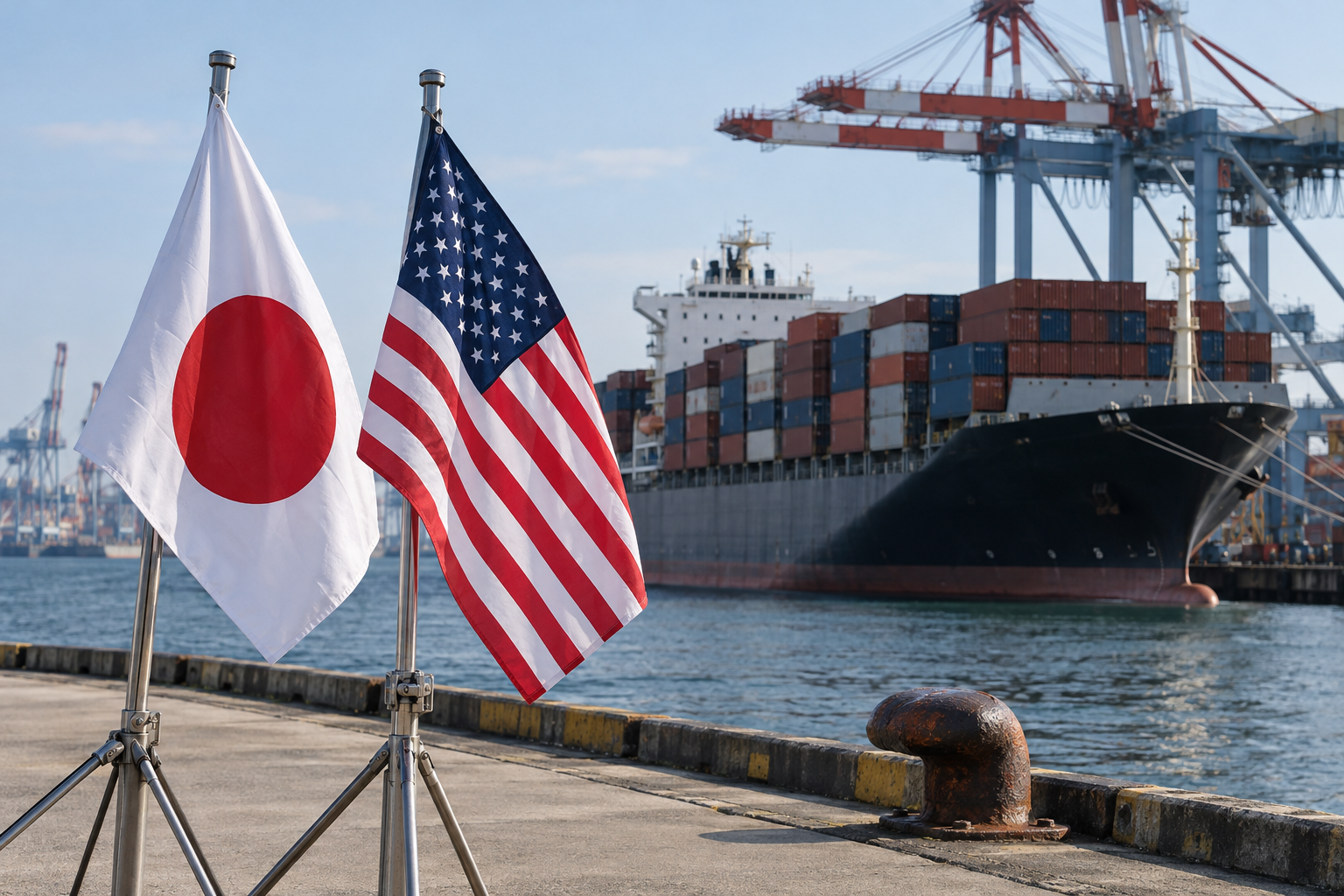
Japan reaffirmed its investment commitment to the United States in the immediate aftermath of Trump’s midterm setback. The Japanese government said the day after the vote that it intended to fulfil its promise to invest in the United States. That decision provides a useful starting point for examining the uncertainty confronting American allies: a president’s electoral setback changes the political setting, but does not by itself tell foreign governments which commitments to preserve, which assumptions to reconsider or what Washington will do next.
The commitment is $550 billion in U.S. investment. That is the central quantitative fact, but it is also important to distinguish a reaffirmed promise from completed investment. The available material gives no disbursement schedule, project breakdown or measure of how much has already been invested. Nor does it establish that the election altered the pledge’s terms. The figure therefore demonstrates the scale of Japan’s stated commitment, not the pace of implementation, the eventual economic return or the extent of any protection against political disruption.
The Japanese government’s stated position is clear: the promise remains in place. The strongest argument for that approach is continuity. An investment relationship need not be treated as an endorsement of every political decision by the administration receiving it. Maintaining a commitment can separate longer-term economic engagement from an electoral reversal. That is an analytical case for Tokyo’s decision, however, not a claim that Japanese officials have supplied this explanation. Their reaffirmation establishes an intention to proceed; it does not establish their full reasoning.
Read more: Can annual climate talks turn promises into action?
The competing signal comes from U.S. voters, who delivered a broad rejection of Trump’s leadership. The strongest argument for reassessment is that foreign partners should not assume an unchanged political environment after such a result. Yet the limits of that argument matter equally. A rebuke to a president is not evidence that voters rejected Japanese investment, demanded changes to this pledge or endorsed a particular alternative economic relationship. Neither Tokyo’s reassurance nor the electoral verdict should be made to carry a policy meaning that has not been demonstrated.
This distinction leaves allies facing a problem of interpretation rather than an automatic choice between loyalty and withdrawal. Preserving an existing commitment may offer predictability when the American response remains uncertain. Reconsidering how that commitment is implemented may also be compatible with preserving it. The available evidence does not show that Japan is changing its approach to implementation. It does, however, support separating the question of whether a promise survives from the question of how investment can proceed under changed political conditions.
The debate around U.S. data centres illustrates why that separation could matter. Building them has become more difficult, while voters have also challenged the artificial-intelligence billionaires associated with them. This supplies a broader context of political resistance surrounding investment, but not a basis for assigning any of Japan’s $550 billion to data centres. No such allocation is provided. The relevant analytical point is narrower: an overall investment commitment cannot, on its own, establish public acceptance of particular projects or resolve the obstacles those projects might face.
Read more: Europe joins U.S.-mediated Russia-Ukraine peace effort in Abu Dhabi
Japan’s regional circumstances also complicate any simple argument for distancing itself from Washington. There have been few signs of a thaw in relations with China one year after Takaichi’s remarks on Taiwan. Japan has also been working to prevent a diplomatic slight to Takaichi involving Xi at a China summit. Those circumstances place the American political reversal alongside continuing difficulties in Tokyo’s other major relationship. They do not prove why Japan reaffirmed its investment pledge, but they caution against treating its choices as a response to American domestic politics alone.
The case for Japanese autonomy consequently need not be framed as the opposite of engagement with the United States. Diplomacy, economic resilience and a credible capacity for deterrence offer distinct ways of preserving room for manoeuvre. In that framework, continuing U.S. investment could coexist with efforts to avoid excessive dependence on any particular political outcome. Equally, the size of the pledge cannot establish that such a balance has been achieved. That would require details about the commitment and its implementation that are not available here.
The competing arguments thus address different risks. The Japanese government’s reaffirmation preserves the commitment despite the election result. The voters’ rejection of Trump challenges any assumption that his previous political standing remains intact. Continuity risks becoming complacency if it ignores that change; reassessment risks overreaction if it treats the result as a rejection of arrangements voters have not specifically repudiated. There is insufficient evidence to attribute either broader position to named officials or to turn these analytical possibilities into competing policy announcements.
What comes next is therefore a test of implementation and political response, not merely of whether the headline pledge remains unchanged. Japan has stated its intention; Trump’s response to defeat remains uncertain. Further detail on how the investment will proceed would help distinguish durable economic engagement from a promise whose practical implications remain unclear. For allies, the central uncertainty is not resolved by choosing between the president and the electorate. It lies in sustaining relationships while recognising that neither an investment announcement nor an election result supplies the whole policy outlook.