Art market · Art
Monet’s ‘Iris’ sets French auction record for artist at €50m
The Paris sale surpassed expectations after nearly 45 minutes of bidding, though the broader French auction record remains higher when adjusted for inflation.
By Calla Brenmoor · 3 min read
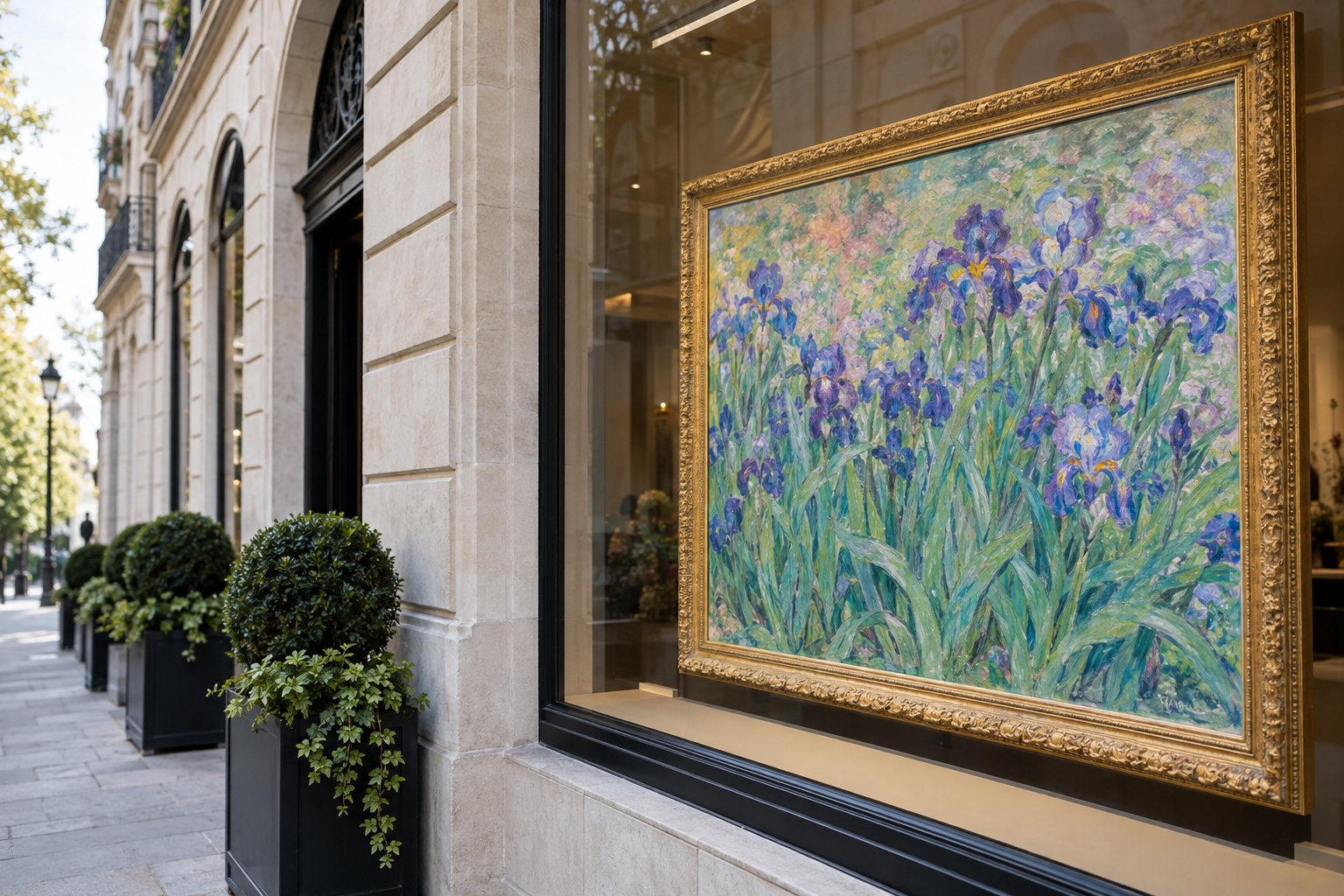
Claude Monet’s Iris sold for €50m, including fees, at Sotheby’s in Paris on 22 October 2026, establishing a French auction record for the artist. The painting, which had not been publicly exhibited since its creation, drew six prospective buyers into a contest lasting nearly 45 minutes. Its sale placed a rarely seen work at the centre of an auction in which every lot found a buyer.
The price, also reported as $56m, exceeded the painting’s estimate of €22m to €30m. Iris led the sale of the Jeanne Schlumberger collection, whose twenty-seven works brought €74.4m, or $83.7m, including fees, against a pre-sale estimate of €40m. Those comparisons require a qualification: the estimates exclude fees, while the reported final prices include them. The results therefore should not be read as a like-for-like measure of the amount by which bidding exceeded expectations.
The successful bid for Iris came from a client participating by telephone through Jen Hua, deputy chairman of Sotheby’s Asia. The bidding contest provides a further measure of interest beyond the final price: six prospective buyers competed over nearly 45 minutes before the work was secured. The involvement of an executive from Sotheby’s Asia identifies the channel through which the purchase was made, rather than establishing the buyer’s nationality or where the painting will ultimately be kept.
Read more: Paris museums close as more than 400,000 protest across France
Painted in 1924-25, Iris is the largest work in Monet’s Iris series. It came from Jeanne Schlumberger, an heir to the Schlumberger oil company, and was offered alongside three other paintings by Monet from her collection. Its scale and absence from public exhibition distinguish it within the sale. Those characteristics provide context for the attention it attracted, although the auction figures alone cannot establish how much weight individual bidders gave to either consideration in determining their offers.
The result also establishes a broader French auction milestone if prices are compared without an inflation adjustment. On that basis, Iris holds the highest price paid for an artwork in France, not only for a Monet. That distinction is separate from the artist’s French record and depends on the basis used to compare transactions across time. The €50m result leads the unadjusted comparison, but it does not displace the earlier benchmark when the effect of inflation is included.
The inflation-adjusted record remains with Pablo Picasso’s Les Noces de Pierrette, sold at Drouot in Paris in 1989 for 314.9m French francs. The historic currency conversion puts that price at €48m; adjusted for inflation to 2026, the figure is €104.2m. These measures offer different readings of the Paris result. Iris has achieved a higher stated euro price than the converted Picasso sale, while the inflation-adjusted comparison preserves the earlier transaction’s position. The qualification matters when describing the scope of the new record.
Read more: U.S. reduces embassy staffing as warnings of Iranian threats intensify
Monet’s worldwide auction benchmark also remains above the Iris result. Meules, painted in 1890, sold at Sotheby’s in New York in 2019 for $110.7m, including fees. The $56m price reported for Iris therefore marks a French achievement rather than a new global high for the artist. Keeping those categories distinct allows the Paris sale to be assessed on its own terms, without extending a national record into a claim about Monet’s entire auction history.
The Schlumberger collection’s performance was not confined to its leading painting. All the works offered sold, and three-quarters finished above their high estimates. That breadth adds substance to the headline total, showing that successful bidding extended across the collection rather than ending with Iris. At the same time, the figures describe this particular group of works. They do not, on their own, establish an equivalent pattern for other collections, other artists or the wider auction market.
Taken together, the bidding duration, the number of prospective buyers and the collection’s complete sell-through provide complementary ways to assess the sale. The €74.4m total captures the value of the sale including fees, while the estimate comparisons describe performance against expectations on a different fee basis. The national and worldwide records answer separate questions again. Reading those measures together gives a more precise account than treating the largest price as a sufficient description of every aspect of the auction.
For Iris, the sale leaves its next public appearance unresolved: the supplied information identifies the telephone bidding route but gives no future exhibition plans. Its auction position is clearer. The painting now sets Monet’s French benchmark and leads the country’s unadjusted artwork-price comparison, while the inflation-adjusted Picasso record and Monet’s worldwide record remain intact. Those distinctions will be the relevant reference points for assessing subsequent claims about the significance of the Paris result.