Art · Art
Paris Internationale brings 56 galleries to Art Basel Paris week
The fair on Quai de Valmy also hosts five nonprofit spaces, while events elsewhere in the city include public sculpture, museum residency exhibitions and shows exploring industrial heritage.
By Calla Brenmoor · 4 min read
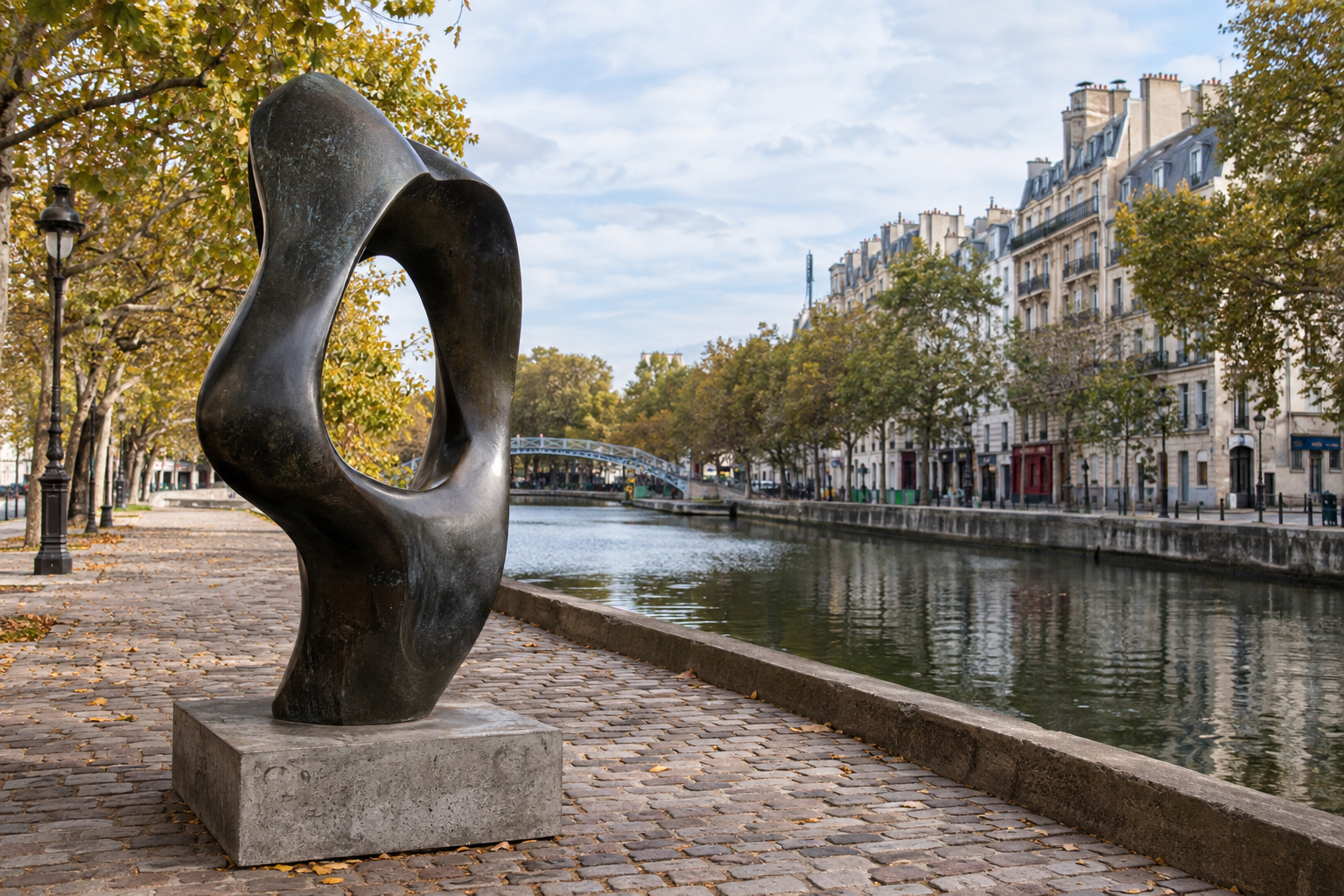
Paris Internationale is drawing attention beyond the main fair during Art Basel Paris week, bringing emerging galleries to the Canal Saint-Martin district while exhibitions across the capital extend the itinerary into museums, public spaces and former industrial settings. These events beyond the fair offer different kinds of encounters with art: works for sale, sculpture viewed alongside a city landmark and museum projects that revisit collections, colonial history and manufacturing.
Now in its twelfth edition, Paris Internationale opened earlier this week on Quai de Valmy and runs until 24 October. It hosts 56 galleries and five nonprofit spaces, bringing both types of exhibitor into the fair. The fair changes venue each year, and its latest location takes visitors away from the city centre. Its organisers emphasise a format intended to bring artists, galleries and audiences into direct contact, making the structure of the event part of its appeal.
For George Vamvakidis of the Athens gallery The Breeder, that approach has practical value. “It feels manageable cost-wise, there is less pressure and it makes a nice change after Frieze,” he says. The gallery is offering works by Greek artist Kostis Velonis and Istanbul-born Eleni Pitari-Pangalou. Alongside the stands, the programme addresses institutional practice. A discussion on 23 October, “Building a Code of Conduct for an Art Organisation: Discomfort and Transformation”, includes ethics practitioner Piergiorgio Pepe and Grégory Castera, head of commissioning at Kanal-Centre Pompidou in Brussels.
Read more: Carrefour warning adds business pressure to France’s cost-of-living unrest
At the Place du Trocadéro, the setting provides a different relationship between art and its audience. Three monumental bronzes by Tracey Emin form part of Art Basel Paris’s public programme near the Eiffel Tower: I Lay Here for You (2018), I Followed You to the End (2024) and I Will Not Be Alone (2025). Their female figures convey retreat, submission and defiance. In a post on 19 October, Emin recalled travelling to Paris after her mother’s death and finding solace in museums, including visits to Rodin’s studio and the Louvre. The installation gives that personal connection a public setting.
The Louvre itself is presenting the results of a sustained engagement with contemporary artists. Kader Attia and Elizabeth Peyton established studios within the museum under its “Les Hôtes du Louvre” initiative, marking its 230th anniversary in 2023. They worked there from December that year until June 2025, and their resulting works are now shown together in the Chapel Room until 14 December. The extended residencies provide a contrast to the concentrated fair-week schedule: these encounters with the museum developed over time rather than through a brief exhibition visit.
The artists’ approaches also differ. Peyton studied the collection alongside young artists from Paris’s Ecole des Beaux-Arts, making copies and interpretations of works in the museum. Her portrait of Napoleon Bonaparte from 2005 appears beside a depiction of Jennifer Lawrence from 2025. Attia’s video examines the conflicting legacies of Bugeaud, the 19th-century military commander. Attia contrasts his heroic status in France with his association with colonial violence in Algeria, citing the enfumade attacks in which resistance fighters and civilians were asphyxiated. Together, the presentations encompass both close study of inherited images and scrutiny of historical memory.
Read more: Trump releases Northeast heating oil with U.S. average at $6.14 a gallon
At the Fondation Cartier, an exhibition centred on Ghanaian artist Ibrahim Mahama also makes room for a wider artistic network. Alongside his recent works and installation are pieces by nine artists and collectives with longstanding connections to him. They include Gideon Appah’s paintings, among them Cecilia (Triptych) (2020-21), and screenprints by Zohra Opoku. That structure places Mahama’s work within a group of continuing relationships, rather than presenting his practice in isolation, and gives visitors a broader view of the artists associated with him.
Mahama’s Things Fall Apart (2026) brings industrial material into the exhibition on a substantial scale. Glass bottles and crates fill the hall, all recovered by the artist from a disused bottle factory in Aboso, southwestern Ghana, and transported to his Red Clay art complex in Tamale. The foundation’s wall text frames this reuse as a way of connecting Ghana’s manufacturing past with its future. The installation thus joins the week’s broader consideration of how objects and sites retain histories when their original functions have ended.
Industrial history also shapes the inaugural exhibition at the new contemporary art centre on Ile Seguin, in western Greater Paris, which opened on 17 October. Curated by Cecilia Alemani, Imaginary Engine brings more than 50 works from the Fonds Renault pour l’Art et la Culture together with 17 new commissions. The island housed Renault’s principal manufacturing plant for much of the 20th century. The exhibition connects that setting to both the company’s existing collection and contemporary artists’ responses to the automobile and its wider associations.
Among the works is Julio Le Parc’s 45-panel Peintures en frise (1971–74), painted with automotive paint and formerly incorporated into the factory’s basement staff cafeteria. Madeline Hollander’s Sunrise/Sunset (2021) uses columns of flashing car headlights to follow the Earth’s rotation, while Shirin Aliabadi’s Girls in Car photographs from 2005 depict Iranian women posing in vehicles in defiance of social constraints. For visitors planning the remaining week, Paris Internationale’s 23 October discussion and 24 October closing provide the immediate dates; the Louvre exhibition continues until 14 December, offering another reason to visit beyond the fairs.