Culture · Culture
Thessaloniki’s Hamza Bey Mosque reopens after nearly 20-year conservation effort
The 15th-century building will serve as a permanent exhibition space and cultural centre managed by the Metropolitan Organisation of Museums of Visual Arts of Thessaloniki.
By Oren Valcett · 3 min read
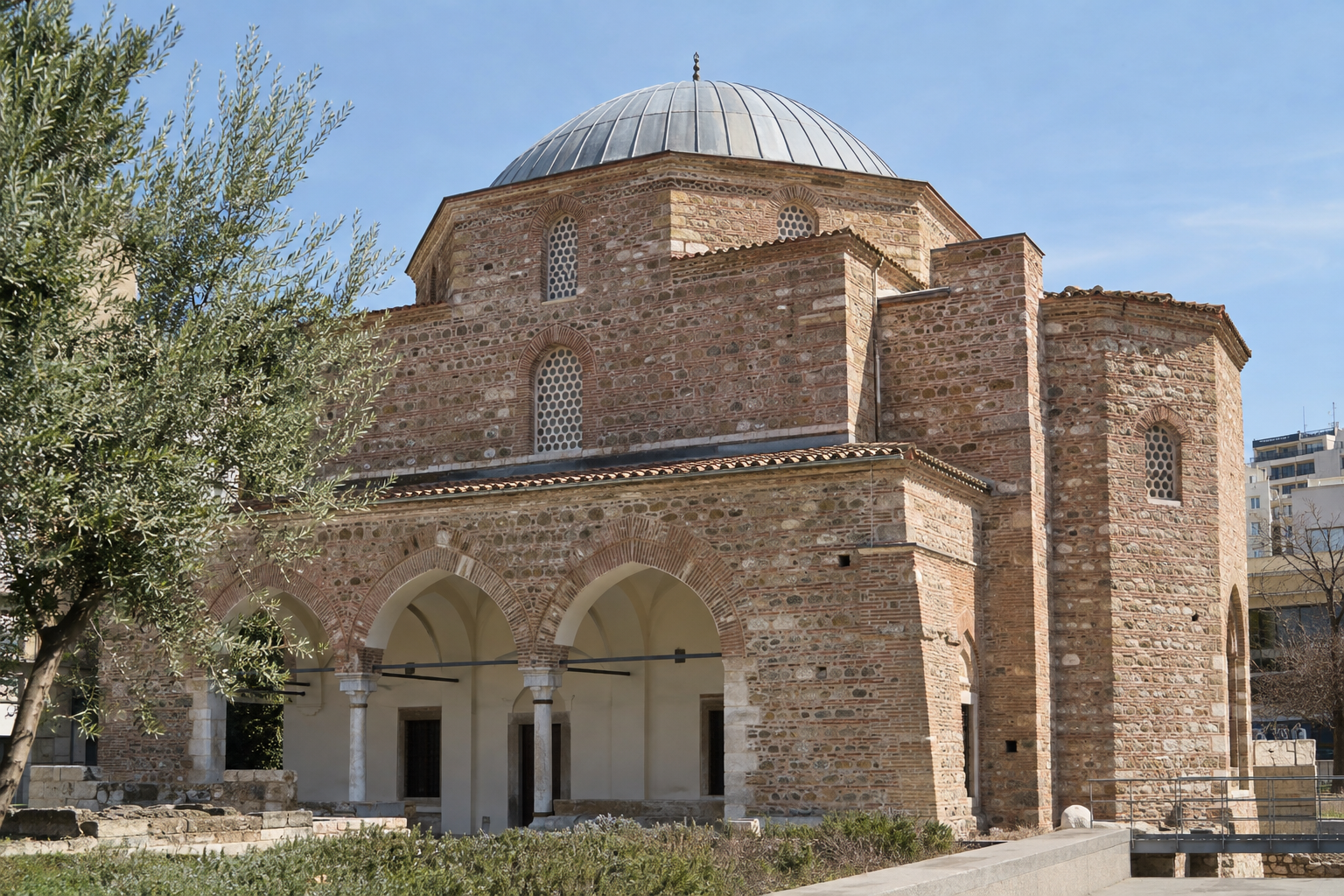
Thessaloniki’s Hamza Bey Mosque has reopened as an exhibition venue after nearly two decades of conservation and restoration, giving the historic building a cultural role after its earlier lives as a place of worship and a cinema. The 15th-century mosque, widely known as Alacazar, reopened in October 2026 with an exhibition of photographs examining the city’s modernisation. Its new use brings the building’s own history of adaptation into the setting for an exhibition about urban change.
The Metropolitan Organisation of Museums of Visual Arts of Thessaloniki, known as MOMus, will manage the site as both a permanent exhibition space and a cultural centre. The conservation effort extended across several distinct phases: the building came under the protection of the Greek ministry of culture in 2006, structural and stabilisation work ran from 2007 to 2023, and the latest work took place in 2024–26. That final phase, supported by the European Recovery Fund, completed the interior and exterior conservation needed for its new function.
The building’s origins reach back to 1467, when it was commissioned by the daughter of the Ottoman admiral Hamza Bey. Its reopening therefore concerns more than the rehabilitation of a former entertainment venue: it also returns an Ottoman religious building to public use in a different form. The mosque’s long architectural history provides a counterpart to the much more recent period explored in the opening exhibition, placing the photographic record of modern Thessaloniki within a considerably older setting.
Read more: Omar seeks donations amid reported federal investigation and home search
An expansion a century after the original commission added a portico, a minaret and a quadrilateral courtyard. Those features made the building architecturally exceptional among mosques in the wider Balkan region. Its fabric also reflects episodes of destruction and reconstruction, rather than an uninterrupted survival in its original state. After damage from fires and earthquakes, the mosque was rebuilt in 1620, when a madrasa was added. Conservation has thus addressed a building shaped by successive interventions over a long period.
A different kind of break came after the population exchange between Greece and Turkey in 1923. During that exchange, two million people underwent compulsory transfer according to their religious affiliation. The building subsequently stopped serving as a mosque. That history places the change in its use within a much larger upheaval, rather than simply a decision about the future of an individual monument. Its current cultural function follows a separation from religious use that began long before the latest restoration programme.
The former mosque later operated for several decades as the Alacazar cinema, undergoing a series of modifications. The cinema shared the name by which the building remains widely known, adding another identity to the religious and architectural ones established earlier. The cinema years are also part of the context for the conservation effort: the building reaching the restorers was not an untouched mosque, but a structure altered for a different purpose after it ceased to be used for worship.
Read more: Kimberly Guilfoyle resigns as ambassador to Greece amid ethics scrutiny
The length of the project reflects its staged progress. According to a spokesperson for the space, structural and stabilisation work proceeded slowly from 2007 until 2023. The 2024–26 phase then completed the conservation required to accommodate exhibitions and cultural activity. These dates distinguish the earlier structural work from the more recent completion of interior and exterior conservation. The European Recovery Fund support is identified with that latest phase, rather than with the nearly 20-year effort as a whole.
The inaugural exhibition, “Thessaloniki: The Footprint of Transition (1960-1980). Through the photographs of Pete Marifoglou”, focuses on two decades of rapid modernisation in the city. Its subject gives the reopened venue a connection between the history presented on display and the history embodied by its surroundings. Marifoglou’s photographs concern a more recent chapter than the mosque’s foundation, expansion or reconstruction, but the exhibition and its setting both address a Thessaloniki that has changed substantially over time.
Epaminondas Christophilopoulos, chairman of the MOMus management board, has emphasised the building’s significance as a witness to the city’s modern history. That description places its modern history alongside its Ottoman origins. The different identities need not be reduced to a choice between a religious monument and a former cinema: both belong to the history of the structure now being used for art. The reopening adds a cultural function without restoring its former role as a mosque.
The next stage is the building’s operation under MOMus as a lasting exhibition venue and cultural centre. With the required interior and exterior conservation complete, attention shifts from the prolonged work on the structure to its use for public cultural activity. The opening photography exhibition establishes that transition through a subject closely tied to Thessaloniki itself, connecting a restored historic site with an examination of the city’s more recent transformation.