Art · Art
A 27-metre batik anchors Bagri Foundation’s first London exhibition
Nomin Zezegmaa’s first UK show brings a monumental installation to St Cyprian’s church in Marylebone, opening the foundation’s annual Springboard exhibition programme.
By Calla Brenmoor · 3 min read
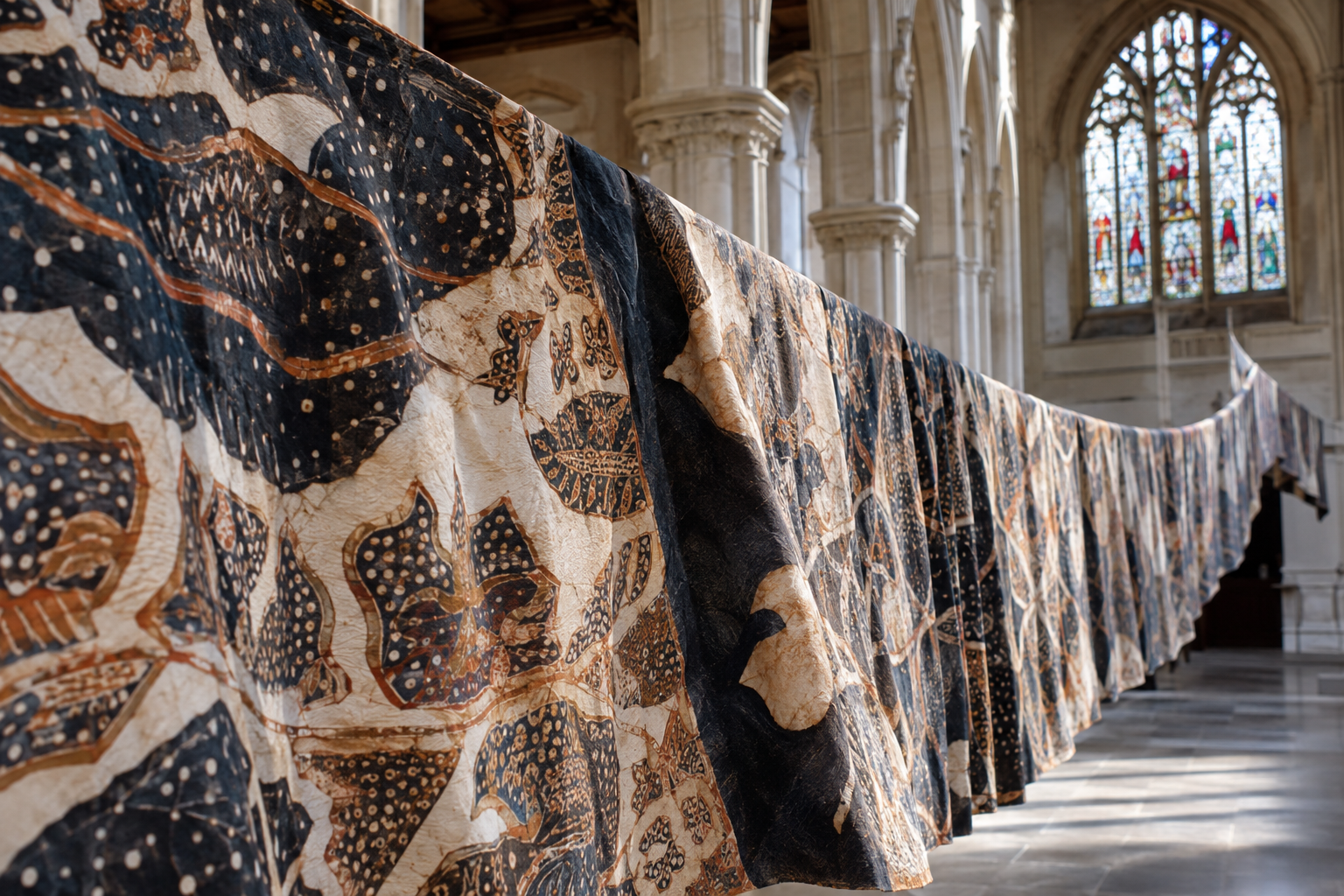
The Bagri Foundation has opened its first London exhibition with a 27-metre batik suspended from the ceiling of St Cyprian’s church in Marylebone. The installation by Mongolian artist Nomin Zezegmaa brings a work of substantial scale into an ornate Gothic setting, but its ambition is not to overpower the building. Instead, the artist has sought a restrained relationship between her work and the architecture, making coexistence with the church central to the exhibition’s approach.
Titled You Who Sing Into Existence, the exhibition runs until 24 October 2026 and is Zezegmaa’s debut UK show. St Cyprian’s is a 15-minute walk from Frieze London, placing the project near the fair while giving it a markedly different architectural setting. The exhibition inaugurates Springboard, the foundation’s new curatorial programme, which is intended to give Asian artists their first UK institutional exhibition annually. Chelsea Pettitt, the foundation’s director, has also curated the presentation.
For the London-based foundation, established in 1990, Springboard adds an exhibition programme to an existing role supporting Asian art and culture. Its wider purpose is to increase international awareness of Asian art and culture, with grants and partnerships supporting artists and exhibitions. The distinction matters: this inaugural exhibition is a new form of activity for an organisation already involved in supporting artists and exhibitions, rather than the beginning of its engagement with the sector. Springboard gives that broader mission a recurring curatorial format in the UK.
Read more: Van Gogh valued at US$180 million on display in Hong Kong
The foundation’s recent projects indicate the institutional context from which the initiative emerges. It has supported exhibitions at the Rijksmuseum, the Saatchi Gallery and the Serpentine Gallery, alongside an artist commission at the Hayward Gallery and The Whitworth in Manchester. Those partnerships place Springboard within a wider network of support. The church exhibition, however, gives the foundation a different task: presenting an artist through a programme of its own, with its director taking responsibility for the curatorial choices as well.
Zezegmaa was born in Germany and is based in Ulaanbaatar, Mongolia’s capital. Her practice draws on Mongol cosmology, landscapes and ancestral memory. Those interests provide the artistic context for the London presentation, rather than allowing the installation to be understood solely as an exercise in filling an unusual venue. The encounter is between a practice rooted in those subjects and a church whose existing architecture the artist has explicitly chosen to acknowledge rather than visually challenge.
Zezegmaa has described wanting the works to make quiet additions to St Cyprian’s, avoiding a struggle for attention with its elaborate Gothic features. That intention offers a useful counterpoint to the installation’s headline measurement. A 27-metre batik might suggest an emphasis on visual dominance; the artist’s stated aim is instead to introduce another layer without disrupting the architectural environment. Scale and restraint are therefore not competing accounts of the exhibition, but different aspects of the relationship she is seeking to establish.
Read more: Fifty years after Arts Britain Ignores, a question of British identity
Pettitt’s account places a different emphasis on the same encounter. She expressed astonishment that the team had succeeded in hanging the batik from the church ceiling. Her response underlines the achievement of bringing a work of this size into the building, while Zezegmaa’s explanation focuses on how it should sit within that space. These are complementary perspectives rather than a disagreement: one concerns the realisation of a monumental installation, the other the degree of attention it asks from its surroundings.
The figures describing the project help distinguish its different ambitions. The batik’s 27-metre measurement establishes its physical scale, while the short walk from Frieze identifies its proximity to the fair. Neither, on its own, explains the longer-term purpose of Springboard. That rests on the annual commitment to giving Asian artists their first UK institutional show. The programme thus joins a temporary presentation in a specific building to a recurring opportunity for artists, extending the significance of the launch beyond the current exhibition.
For this first edition, the curatorial choice also makes the venue more than a location. Because Zezegmaa has identified the church’s architecture as something her work should accommodate, the setting becomes part of the terms on which the installation is presented. The project’s central tension is consequently not between opposing critical views, but between monumentality and deference. Its size is immediately concrete; its intended restraint depends on the relationship the artist has sought between the suspended work and the existing interior.
You Who Sing Into Existence closes in the week after Frieze, with 24 October marking the end of the presentation at St Cyprian’s. Beyond this exhibition, Springboard is intended to provide first UK institutional shows on an annual basis. The inaugural project establishes the programme through a first UK show, a substantial installation and a setting that asks for architectural sensitivity. For the foundation, it also adds the shaping of an exhibition through its own curatorial initiative to its existing role supporting exhibitions elsewhere.