Public art · Art
About 250 people attempt to move Chicago’s ‘Bean’
Anish Kapoor’s 110-ton Cloud Gate remained in place after a crowd tried to shift the Millennium Park landmark on Sunday.
By Calla Brenmoor · 3 min read
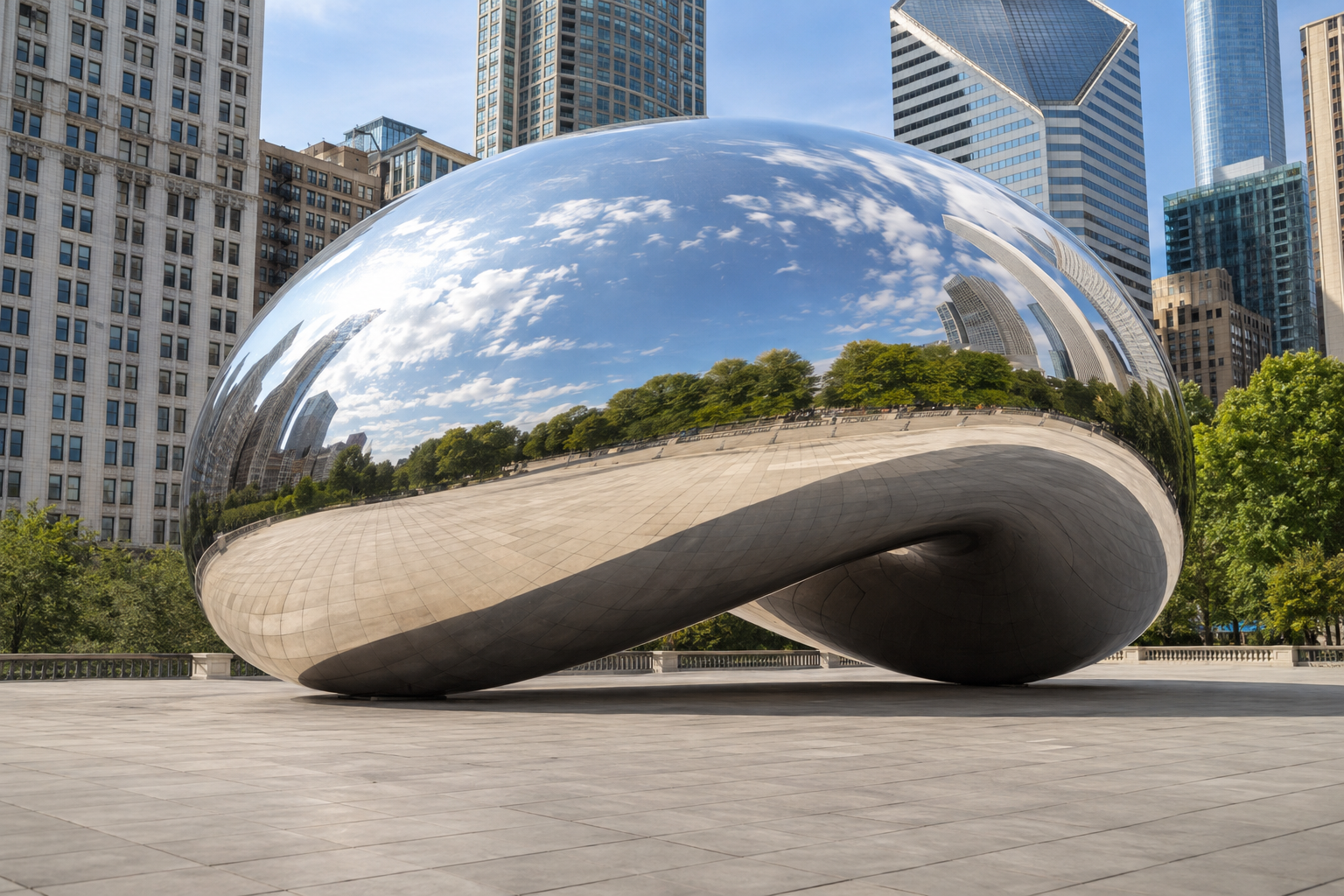
About 250 people tried to shift Anish Kapoor’s Cloud Gate in Chicago on Sunday, but the steel sculpture known as the Bean did not move. The gathering brought a collective physical effort to a landmark whose familiar nickname contrasts with its considerable weight. The objective was modest in distance — to move it a few inches — but the outcome was unambiguous: the sculpture remained where it stood in Millennium Park.
The central figures describe the scale of the attempt: a crowd of about 250 people and a sculpture weighing 110 tons. Cloud Gate dates to 2006, giving the episode a setting in an established work rather than a newly installed attraction. The attendance figure is approximate, not a precise count. Even so, it places the gathering in the hundreds, while the reported result provides no indication that the participants achieved the displacement they sought.
The distinction between the size of the crowd and the result matters. A substantial turnout is evidence of participation, but it is not evidence that the sculpture came close to moving. Nor does the short distance contemplated make the task itself small. The available account establishes an attempt and its failure; it does not provide the technical information needed to assess the forces involved. Any calculation of what the participants might have been able to accomplish would go beyond those facts.
Read more: Shanghai’s art scene seeks resilience amid economic uncertainty
The work’s identity is also central to the episode. Cloud Gate is the formal title of Kapoor’s sculpture, while the Bean is the name by which it is widely known. In this instance, the landmark became the object of a group action directed at the artwork itself, rather than simply a backdrop to activity in the park. That distinction gives the gathering its particular character: the proposed outcome was a physical change in the position of an existing sculpture.
The latest effort also follows an earlier claim involving someone supposedly trapped inside the work. Alderman Brendan Reilly rejected that claim, saying nobody was trapped in the sculpture. He also joked that the man had been “freed years ago.” His denial is important context, but the joke should not be read as confirmation that anyone had previously been confined there. The available material does not establish a connection between that earlier claim and the people who gathered on Sunday.
Reilly’s office did not respond to a request for comment on the latest attempt, and neither did Kapoor’s studio. The available material includes no interpretation of the gathering from either Reilly’s office or Kapoor’s studio to set alongside the participants’ effort. It would therefore be misleading to describe the action as either endorsed or condemned by them. Reilly’s earlier remarks addressed the claim about a trapped person, not the subsequent initiative to move the sculpture a few inches.
Read more: Europe joins U.S.-mediated Russia-Ukraine peace effort in Abu Dhabi
A separate example of a reflective sculpture with a popular nickname is Gregor Kregar’s Reflective Lullaby, the 30-foot work known as the Chrome Gnome at McClelland Sculpture Park and Gallery, just outside Melbourne. The comparison is one of naming, not of events: the supplied account describes no similar attempt involving Kregar’s work. It nevertheless offers context for the Bean’s identity, showing another instance in which a sculpture’s informal name sits alongside the title given to the artwork.
The measurements attached to the works also require care. Cloud Gate’s 110 tons describes its weight, while Reflective Lullaby’s 30-foot measurement describes its scale in a different way; the figures do not provide a basis for ranking the two. For the Chicago gathering, the relevant contrast remains between the sculpture’s weight and the crowd’s unsuccessful effort. The account gives no basis for assigning a numerical contribution to individual participants or estimating how many people a different attempt might require.
There is similarly little basis for treating the gathering as a single statement about Kapoor or his work. The action establishes that people tried to move the sculpture, but no participant’s explanation is included in the available material. It cannot reliably be characterised as criticism, homage or a proposal for permanent relocation. A sober reading separates the observable episode — a crowd attempting a small displacement — from interpretations of its purpose that would require testimony from those involved.
What follows remains unresolved in the available account. With no response from Reilly’s office or Kapoor’s studio, there is no stated next step from either to report. The clear outcome is narrower than the spectacle of hundreds gathering around a landmark: Cloud Gate stayed in place. Any further account would need to distinguish new developments from the earlier rumour and from speculation about the crowd’s intentions. For now, the attempted move changed neither the reported position of the Bean nor its place in Millennium Park.