Art market · Art
Klimt landscape returns to auction with estimate of up to $80 million
7 million sale set a record for the artist’s landscapes.
By Calla Brenmoor · 3 min read
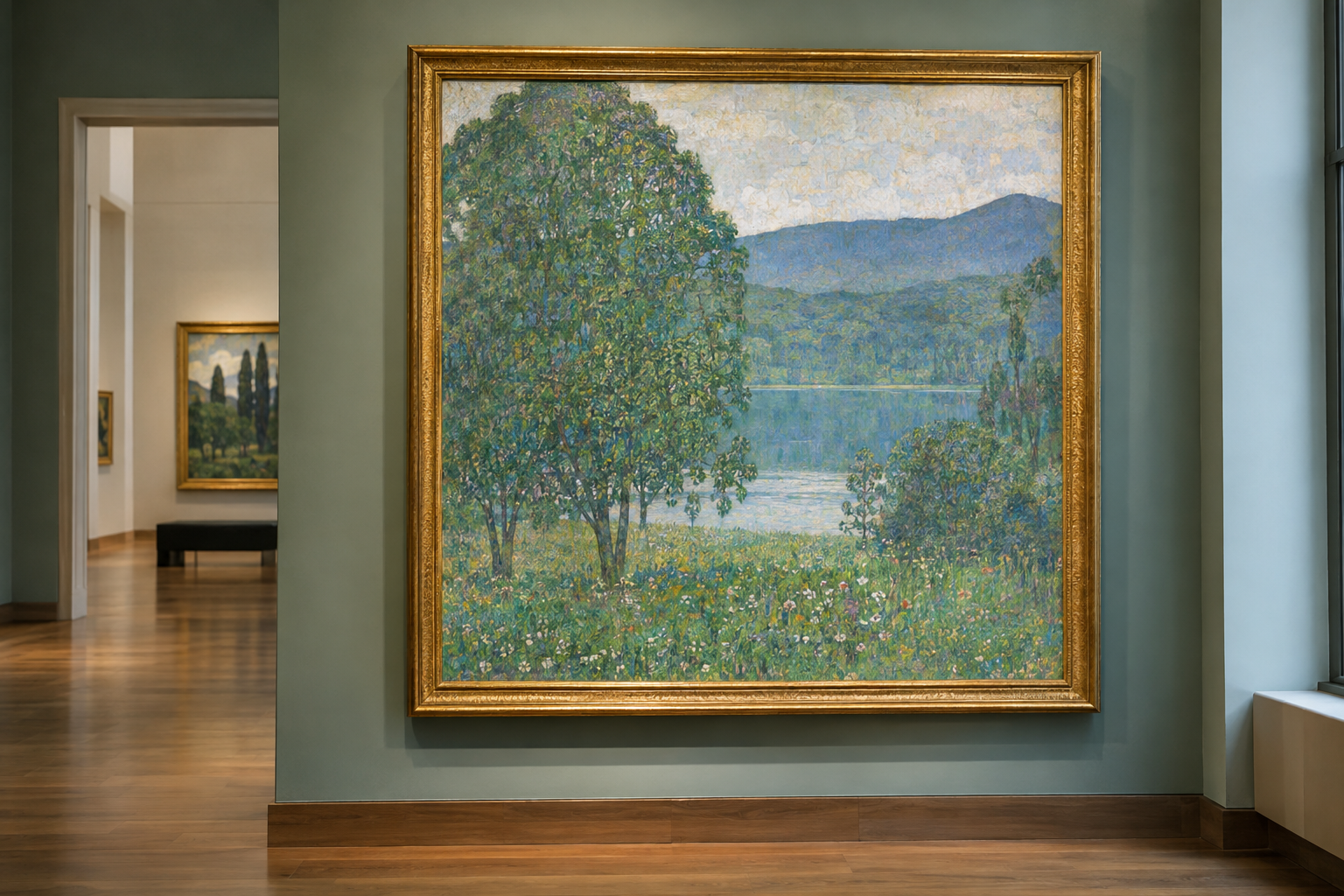
A Gustav Klimt landscape that previously set an auction record for his landscape paintings is returning to the market with an estimate of $60 million–$80 million. Christie’s will offer Litzlbergkeller, painted in 1915–16, at its 20th-century evening sale in New York on November 17, 2026. The painting depicts an inn and brewery amid the greenery beside Austria’s Lake Attersee, bringing a countryside subject to a November auction programme that also includes a major work by Wassily Kandinsky and pieces from Jeff Koons’s collection.
7 million it brought at Sotheby’s when it was sold following the death of its former owner, Serge Sabarsky. That result more than doubled the previous auction record for a Klimt landscape. Its return now comes against a different set of benchmarks: other landscapes by the artist have achieved $86 million and $104.5 million. The forthcoming sale will test the estimate against bidding for a work whose earlier appearance set a record for this part of Klimt’s output.
Litzlbergkeller takes its name from the Litzlberg Cellar, the brewery and inn at the centre of the composition. Klimt surrounded the building with foliage, using flattened areas of green and fine stippling to describe the setting. Reflections extend the scene into the water, while the absence of people leaves the architecture and vegetation to carry the image. The subject belongs to the countryside around Attersee, where Klimt spent his summers from 1900 until his death in 1918, rather than to the portraiture responsible for his highest auction prices.
Read more: Art Basel Qatar names 82 galleries for 2027 amid regional war fears
Max Carter, Christie’s global chairman of 20th- and 21st-century art, highlighted the painting’s movement from clearly described greenery towards more abstract reflections at the edge of the lake. His assessment emphasised the lushness and clarity of the upper part of the painting and the jewel-like abstraction of the reflections. Carter also described the valuation as “the most conservative estimate for one of Klimt’s mature landscapes in nearly 10 years”. That is the auction house’s assessment ahead of the sale, rather than a price established by buyers.
Recent landscape results provide context for that argument without determining what Litzlbergkeller will fetch. Birch Forest, dated 1903, remains Klimt’s highest-selling landscape at auction, having achieved $104.5 million at Christie’s in 2022. In the 2025 sale of works from Leonard Lauder’s collection, Blumenwiese, painted around 1908, brought $86 million, while Waldabhang bei Unterach am Attersee, from 1916, sold for $68.3 million at Sotheby’s. Both Lauder landscapes rank among Klimt’s 10 most expensive works sold at auction, giving the forthcoming offering several relevant price comparisons.
Those results also show why the estimate should be read as a range rather than as an expected record. The $68.3 million achieved by Waldabhang bei Unterach am Attersee falls within the valuation for Litzlbergkeller; the $86 million for Blumenwiese sits above it. Even the upper estimate is below the price of Birch Forest. Against those comparisons, Carter’s characterisation is an argument for the painting’s relative value, not a claim that the November sale is certain to reset the landscape benchmark.
Read more: Italy and African partners expand cooperation against art trafficking
Portraiture remains the more expensive category at the top of Klimt’s auction market. Portrait of Elisabeth Lederer, painted in 1914–16 and also from Lauder’s collection, sold for $236.4 million at Sotheby’s in 2025, setting the artist’s overall auction record. That result offers a separate measure of demand for Klimt, but it is not a landscape comparison. For Litzlbergkeller, the recent sales of countryside subjects provide the closer context for assessing Christie’s estimate and the distance travelled since its own earlier record-setting appearance.
The painting’s ownership history adds another dimension to its return. Although Klimt’s landscapes generally grew out of his personal attachment to Attersee, Litzlbergkeller was commissioned by Otto Primavesi, the banking magnate and longstanding patron of the artist. It subsequently belonged to anthropologist and photographer Hugo Bernatzik, then Kurt Wieser, before entering Sabarsky’s collection. Sabarsky, a co-founder of the Neue Galerie, was a committed advocate of Klimt and organised the artist’s first exhibition in Japan in 1981.
Christie’s will place the landscape alongside another work carrying the same $60 million–$80 million estimate: Kandinsky’s Betonte Ecken, dated 1922–23. That valuation puts the Kandinsky in contention for an artist auction record. A selection of nine works from Koons’s collection could bring in up to $100 million. Together, the offerings give the evening sale several substantial price expectations, with the Klimt positioned as a leading lot rather than the only work at that valuation level.
The November 17 auction will take place just days after the Neue Galerie reopens following a renovation closure lasting several months, providing an institutional connection to the painting’s former owner. Attention will then move from Christie’s valuation to the auction result: whether Litzlbergkeller sells within its estimate, and where that price places it alongside the landscapes that have since overtaken its historic record.