Art · Art
Shanghai art week tests the resilience of a slower-growing market
Two established fairs anchor Shanghai’s annual art week as galleries seek young artists and new collectors, while the wider art community draws on regional connections amid China’s economic slowdown.
By Calla Brenmoor · 4 min read
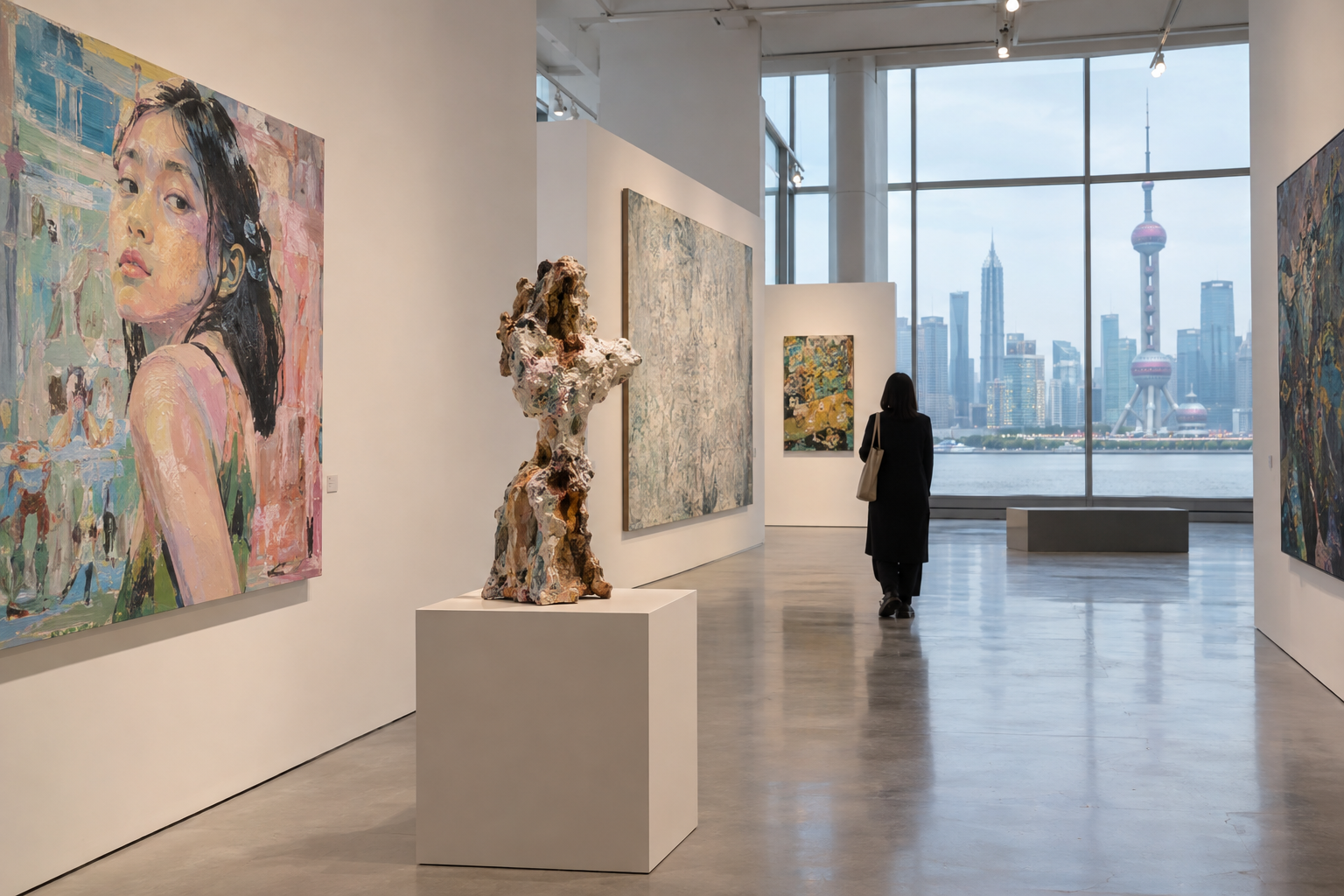
Shanghai’s annual art week opens with galleries, museums and artists confronting a question that extends beyond the fairs: whether the cultural infrastructure built over three decades can sustain the city’s contemporary art scene through economic uncertainty. Shanghai’s core galleries have largely survived China’s property crash and deflationary economy, but sustaining their businesses requires young artists and new collectors. The week’s exhibitions and collaborations offer a view of how institutions are responding, through established commercial channels and smaller, artist-led initiatives.
Running from 10-15 November 2026, art week centres on West Bund Art & Design, held over the same dates, and Art021 Shanghai, which runs from 11-14 November. Founded in 2014 and 2013 respectively, the fairs help establish the mood for the wider market. Hangover Shanghai, a boutique fair holding its second edition from 11-15 November, adds another outlet. In a city of 25 million people, those gatherings concentrate attention on an art community whose activities extend well beyond the annual fair calendar.
That underlying breadth is central to the case for resilience. Lorenz Helbling, who founded ShanghArt in 1996, describes a volume of artistic activity comparable to New York’s, although visitors may find it less immediately visible. His gallery now operates in Shanghai, Beijing and Singapore. International galleries including Almine Rech, Perrotin and Lisson maintain Shanghai spaces, alongside Japan’s Ota Fine Arts and Korea’s Arario Gallery. Local businesses such as Antenna Space, Gallery Vacancy, Capsule Gallery and Don Gallery provide further continuity for artists and audiences throughout the year.
Read more: Mariko Mori returns to Japan’s spotlight with first solo show in 24 years
Museums give that commercial network a broader institutional base. State-backed venues include the Power Station of Art, Museum of Art Pudong and West Bund Museum, which has a partnership with the Centre Pompidou in Paris. Private museums have expanded since the 2010s, with Rockbund Art Museum, Long Museum and Yuz Museum among the best known. Fotografiska, the Museum of Glass and non-profit spaces including Pond Society and Longlati add different programmes and audiences. This variety provides opportunities to encounter art outside the buying and selling concentrated at fairs.
The accumulated history matters as much as the current schedule. Helbling identifies the Shanghai Biennale’s internationalisation in 2000, the SH Contemporary fair’s 2007-14 run and the expansion of galleries and museums as parts of a longer period of development. Otto Neu, who co-founded Nan Ke Gallery in 2022, says Shanghai has spent more than two decades developing audiences and familiarity with contemporary art. Those milestones indicate an established cultural base, but they do not remove the pressure of a changed economic environment on galleries and artists.
Lise Li, who founded Vanguard Gallery in 2004, sees Shanghai as continuing to grow, though at a substantially slower pace. Her gallery’s art-week commitments illustrate the range of activity: participation in Hangover Shanghai and Art021, a Tang Chao exhibition at the gallery, and collaboration on a group exhibition at the artist-run 33ml Offspace. Vanguard artists also have projects nearby, with Liao Fei showing at Hangzhou’s Imagokinetics and Jiū Society exhibiting at Nanjing’s Beiqiu Museum of Contemporary Art. Li reports more institutions and young artists, while finding much exhibition programming cautious.
Read more: California voters reject proposed 5% billionaire wealth tax, projections show
Neu offers a more demanding assessment of the commercial conditions. He says the wider economic shift has made survival and continued activity harder for both artists and galleries. Nan Ke is presenting a group exhibition connecting art and literature during fair week. Nevertheless, Neu believes difficult conditions can encourage greater discipline and clarity of purpose. Li also identifies structural constraints beyond demand: Shanghai’s high living costs and a shortage of platforms carrying art information, including in Chinese. Cultural breadth therefore coexists with practical obstacles to participation and discovery.
There are differing views, too, on how effectively Shanghai’s community works together. Neu values the independence of its galleries, institutions, artists and collectors, describing professional relationships as less dependent on personal obligations than in Beijing. Yet he argues that economic disruption makes closer mutual support more important. Helbling places greater emphasis on the interaction already taking place among Shanghai’s artistic circles and on the relative accessibility of its art neighbourhoods. Their assessments suggest that preserving independence and strengthening collaboration need not be opposing goals.
New audiences may also come from neighbouring creative fields. Collector Cherry Xu opened Cheruby, a space combining art and fashion, in 2025, drawn by Shanghai’s openness. She sees growing exchanges among artists, designers, musicians and fashion practitioners as a route to broader participation. For art week, Cheruby is presenting a solo exhibition by Thai multidisciplinary artist Tanat Teeradakorn. Xu also describes increasingly direct relationships across Asian cities, with creative practitioners looking towards Tokyo, Seoul, Hong Kong, Singapore and Bangkok rather than treating Europe and the US as their default reference points.
Beyond this week, cultivating artists and sustaining those connections remain priorities. Helbling is concentrating on emerging talent through group exhibitions and dialogue, including with artists whose education and working lives span China and the West. Neu regards expanding art communities elsewhere in China as potential sources of audiences and exchange, rather than simply competitors. The fairs will provide a concentrated test of market sentiment; the longer-term task is maintaining the year-round relationships among artists, galleries, museums and collectors on which Shanghai’s cultural development has depended.